Showing posts with label relics. Show all posts

Friday, December 27, 2019

December 26. St Stephen's Day 2019


December 27, Christmas Day 3

December 26, St. Stephen’s Day

This is the one day of the year when we should all hear the carol about the Bohemian king Wenceslas (who was a 10th-century duke of Bohemia) who braved the bitter winter weather and snow to distribute alms to the poor. The carol was written by the hymn writer that should be familiar to all Episcopalians since there are so many of his hymns and translations of hymns which appear in the 1982 Hymnal.  John Mason Neale wrote the lyrics before 1853 and they were set to “Tempus adest floridum” that was first published in the 1582 collections of songs, Piae Cantiones.
            
Good King Wenceslas looked out, on the Feast of Stephen,
When the snow lay round about, deep and crisp and even;
Brightly shone the moon that night, tho' the frost was cruel,
When a poor man came in sight, gath'ring winter fuel.         
The last two lines:
            Therefore, Christian men, be sure, wealth or rank possessing,
Ye who now will bless the poor, shall yourselves find blessing.

I had many errands to do yesterday, and never once did I hear the carol, though it was played often before Christmas Day.

St. Stephen

The story of Saint Stephen is written in the Acts of the Apostles 6.1-8.2.  He probably lived from 5-34 BCE. Though Stephen is a Greek name, he was Jewish given his lengthy speech to the Sanhedrin defending himself and outlining how Jesus fulfilled the Law, not subvert it. The Apostles gained so many converts, Jews and Greek-speaking Jews, that they were failing in their duty to care for the poor, especially widows of the Greek-speaking converts. The Acts of the Apostles states that the Hellenists (Greek-speaking Jews) complained that their widows were being slighted in favor of the Hebrew/Aramaic speaking widows. The Apostles decided to delegate what they saw as a burdensome, less worthy duty to deacons so that the Apostles could continue their preaching. 

The Apostles laid hands upon, ordained, seven deacons, of which Stephen was the first. Stephen was a very zealous and effective preacher and teacher among the Greek-speaking Jews especially in the three synagogues of the Freemen, and Cyrenians, and Alexandrians.  It is not known which group of freed Jewish slaves and their descendants that comprised the Freemen. The most likely group were the Jews who were taken as slaves by General Pompey when he conquered Judea in 63 BCE who had returned to Judea.  Cyrene was a Greek-speaking town in what is now Libya. Alexandria is in Egypt. The Jews in these synagogues were exceedingly angry with Stephen. They hauled him before the Sanhedrin. They claimed that Stephen’s teachings were blasphemous against Moses and God. The trial was not completed before the inflamed mob grabbed Stephen and stoned him to death. Stephen was the first martyr to the faith that did not even have the name Christian yet.

I think there are two points in Stephen’s summary of the history of the Jews from Abraham that cause the rage of the mob to become murderous. First, he quoted Isaiah 66.1 against the Temple in Jerusalem. Acts 7.48. “Yet the Most High does not dwell in houses made by human hands; as the prophet says,”

Isaiah 66.1. Thus says the Lord: Heaven is my throne and the earth is my footstool;
what is the house that you would build for me, and what is my resting place?

Then Stephen immediately called his listeners. Acts 7.51-52a “‘You stiff-necked people, uncircumcised in heart and ears, you are for ever opposing the Holy Spirit, just as your ancestors used to do.  Which of the prophets did your ancestors not persecute?’”

Saul of Tarsus witnessed Stephen’s stoning death. After Stephen’s death, his body was buried by “Godly men” who deeply mourned his death. No place of death or burial is mentioned in the Acts of the Apostles.

The Feast of St. Stephen on December 26th is from a wholly different story, and that is the finding of the bones of St. Stephen.  In 415 CE, a priest named Lucian supposedly dreamt of the locations of Stephen’s bones at Beit Jimal, an ancient small town west of Jerusalem. The relics were taken in procession to the Church of Hagia Sion on 26 December 415. Thus, the Feast of St. Stephen is the day his relics were carried (translated) to the Church of Hagia Sion, a Byzantine church built on Mount Zion. This church built by Emperor Constantine was destroyed during the Persian or Sasanian conquest of Jerusalem in 614. Stephen’s bones did not find rest but were moved several more times and distributed to many places before being taken to Rome by Pope Pelagius II (pope from 579-590). They were entombed with those of St. Lawrence in the Basilica di San Lorenzo fuori le Mura. The Golden Legend tells that the body of St. Law(u)rence rolled over so that there was enough room in the sepulcher to place the bones of St. Stephen.

There are a sizeable number of stained-glass windows retelling the story of the life of Stephen as told in the Acts of the Apostles as well as later events including the finding of his bones in the 5th century.

Photos credits. All photos are from Painton Cowen. 


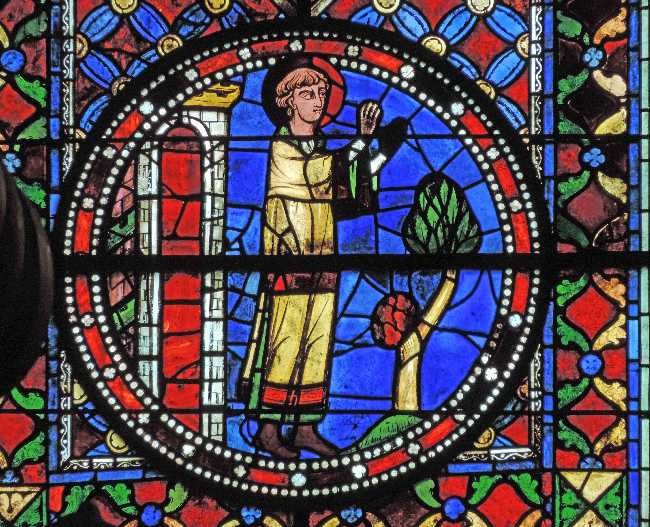
Stephen entrusted with his mission. Laon Cathedral east window c.1210-1215. http://www.therosewindow.com/pilot/Laon/images/w1-01-576A2181.JPG

Stephen preaching. Sens Cathedral. window 102 1230-1240. http://www.therosewindow.com/pilot/Sens/Images/w102-A1-DSCN4184.JPG

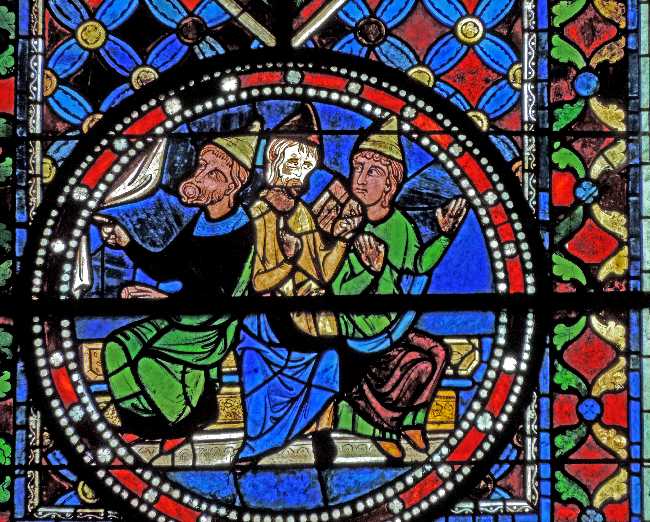
The listeners to the preaching. Sens Cathedral. window 102 [Note the Jews’ hats] http://www.therosewindow.com/pilot/Sens/Images/w102-B1-DSCN4186.JPG

Stephen is denounced. Sens Cathedral. window 102. http://www.therosewindow.com/pilot/Sens/Images/w102-A2-DSCN4183.JPG

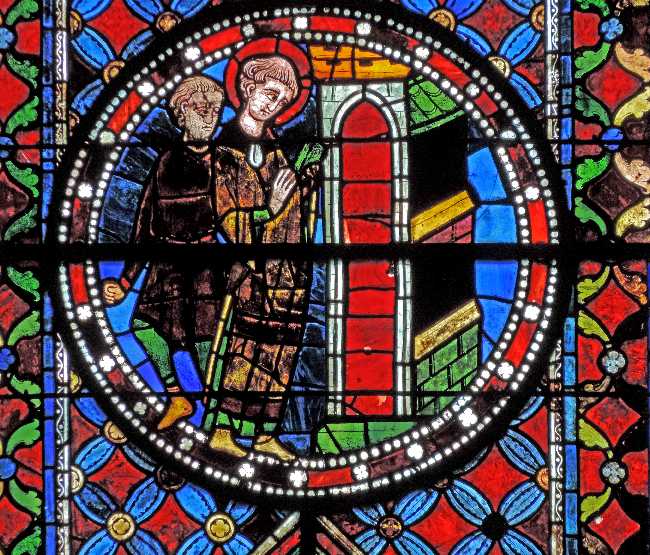
Stephen is imprisoned. Sens Cathedral window 102.  http://www.therosewindow.com/pilot/Sens/Images/w102-B2-DSCN4187.JPG

Stephen before the High Priest. Normandy 1230-1240 now in Victoria & Albert. 
Museum no. C.20-1980 [(PW) 2003]

Stephen before the Sanhedrin. Laon Cathedral. East window 1210-1215.  http://www.therosewindow.com/pilot/Laon/images/w1-03-576A2184.JPG

Stephen before the Sanhedrin. Chartres Cathedral. window 13. http://www.therosewindow.com/pilot/Chartres/images/w13-6-CAN_1879.JPG

Stephen led out to be stoned. Chartres window 13. http://www.therosewindow.com/pilot/Chartres/images/w13-8-CAN_1887.JPG

Stephen led out to be stoned. Laon Cathedral. East window. http://www.therosewindow.com/pilot/Laon/images/w1-04-576A2183.JPG

The stoning of St. Stephen appears in so many windows that I chose only two.
The stoning of Stephen. Bourges Cathedral. window 10. c.1210-1215. http://www.therosewindow.com/pilot/Bourges/images/w10-9-576A2439.JPG

The stoning of Stephen. Chartres Cathedral window 13. http://www.therosewindow.com/pilot/Chartres/images/w13-10-IMG_10670.JPG

Saul, seated, is given a garment from Stephen after the stoning. Sens Cathedral
http://www.therosewindow.com/pilot/Sens/Images/w102-A3-DSCN4182.JPG

Stephen is buried. Chartres Cathedral. 13th century. http://www.therosewindow.com/pilot/Chartres/images/w13-11-CAN_1881.JPG

 
The priest Lucian leads Bishop John to the relics of Stephen. Auxerre Cathedral. 13the century.
http://www.therosewindow.com/pilot/Auxerre/images/w16-1-IMG_9583.JPG

The relics are reburied with dignity and a healing rain falls on December 26, 415 CE.  Bourges Cathedral. Window 15. 1210-1215. 
http://www.therosewindow.com/pilot/Bourges/images/w15_8-30949.jpg

I have made no attempt to include all the different windows about the miracles associated with the relics of St. Stephen, many of which are included in the Legenda Aurea. Bishop Augustine of Hippo included miracles associated with St. Stephen in the City of God, Book XXII, Chapter VIII. Of Miracles Which Were Wrought that the World Might Believe in Christ, and Which Have Not Ceased Since the World Believedhttps://sourcebooks.fordham.edu/source/augustine-cityofgod-22-9-10.asp

As I wrote above the relics of Stephen were moved several times including within the area of Jerusalem, Jerusalem to Constantinople and then to Rome.  There is a set of six windows telling the story of the removal of the shrine of Stephen's relics from Jerusalem to Constantinople in the Cathedral of Our Lady, Chartres.

The shrine of St. Stephen is put aboard a boat.  Chartres window 13.  http://www.therosewindow.com/pilot/Chartres/images/w13-15_10086.jpg

The devil lets loose a storm. http://www.therosewindow.com/pilot/Chartres/images/w13-18-CAN_1902.JPG

The boat arrives safely thought the devil is still lurking above. 
http://www.therosewindow.com/pilot/Chartres/images/w13-19-CAN_1905.JPG

A crowd of the sick and infirm welcome the arrival of the boat with the relics of St, Stephen with their apparent miraculous ability to cure.
http://www.therosewindow.com/pilot/Chartres/images/w13-20-CAN_1897.JPG

The relics are removed from the boat. 
http://www.therosewindow.com/pilot/Chartres/images/w13-21-CAN_1904.JPG

The reception of the relics at Constantinople.
http://www.therosewindow.com/pilot/Chartres/images/w13-22-CAN_1899.JPG

   
Orders were given to transfer the relics of St. Stephen from Constantinople to Rome in order to save the Emperor Valentinian II's daughter Eudoxia. Bourges Cathedral. Window 15, panels 17 and 18.
http://www.therosewindow.com/pilot/Bourges/images/w15_17-30962b.jpg
http://www.therosewindow.com/pilot/Bourges/images/w15_18-30955b.jpg


The remains of St. Stephen moved to Rome.
Bourges Cathedral. window 15, panel 19.
http://www.therosewindow.com/pilot/Bourges/images/w15_19-30954.jpg

The top panel of the St. Stephen window at Chartres Cathedral, window 13 shows two angels carrying the soul of Stephen to heaven.  This ends this blog for today.

Stephen's soul carried to heaven by angels. Chartres Cathedral. window 13, top panel.
http://www.therosewindow.com/pilot/Chartres/images/w13-23_10076.jpg


Sunday, August 30, 2015

Cathedral of Our Lady, Amiens, Picardy, France


Cathedral of Our Lady, Amiens, Picardy, France.  West front.
Photo credit for exteriors and nave: Andrew Tallon
<http://mappinggothic.org/archmap/media/buildings/001000/1063/images/
700/1063_00004_w.jpg>
Lower west front with tympani, jamb sculptures, archivolt sculptures
<http://mappinggothic.org/archmap/media/buildings/001000/1063/images/700/1063_00061_w.jpg>

Chevet (east) end of the cathedral with projecting chapels especially the Chapel of the Virgin.  Note the height of the  windows in the chapels.
<http://mappinggothic.org/archmap/media/buildings/001000/1063/images/700/1063_00055_w.jpg>

Nave looking east.  The triforium of the nave is blind, that is there are no windows.  But the same level in the choir has windows that admit much light to the building.  Most of the stained glass has been lost. 
<http://mappinggothic.org/archmap/media/buildings/001000/1063/images/700/1063_00135_w.jpg>

     So much has been written about the Cathedral of Our Lady at Amiens, Picardy, France, that there is nothing new that I can add. I will instead present a summary of what some art historians consider the finest and, during the Middle Ages, the largest Gothic church in France and Europe.

     Several churches existed on the site of the Amiens cathedral including a Romanesque church built between 1137 and 1152. It was at this cathedral that King Philip II Augustus married his second wife, Ingeborg of Sweden. This is the queen for whom the spectacular Ingeborg Psalter was commissioned that was discussed previously under the blog for the Soissons Cathedral.

     In 1206 the purported head (or more accurately the front facial bones of the skull without mandible) of John the Baptist was brought back to Amiens from the sacking of Constantinople during the Fourth Crusade. Wallo or Walon de Sarton, from Picardy, discovered a half-ball of transparent crystal that contained the facial section of a human skull resting on a silver plate. It was apparently one of two relics he acquired. The other was the head of Saint George. The Greek lettering around the plate said that the bones were from John the Baptist but he could not read the Greek and so went from monastery to monastery trying to get information. Walon gave the skull to the bishop at Amiens. This made the Cathedral of Our Lady a very prestigious site and soon a major pilgrimage site in France. The presence of the skull fragment brought in a substantial income to the cathedral. ( See these three books for more details: Alfred J Andrea Contemporary Sources for the Fourth Crusade: Revised Edition (2008) Leiden, The Netherlands: Brill. David M. Perry. Sacred Plunder: Venice and the Aftermath of the Fourth Crusade. (2015) University Park, PA: Pennsylvania State University Press. Charles Freeman Holy Bones, Holy Dust: How Relics Shaped the History of Medieval Europe (2012) New Haven: Yale University Press.)

     Thus, when the Romanesque church was severely damaged by fire in 1218, construction on a new cathedral in the new Gothic style began in 1220. The cathedral was mostly complete in a short period of time for medieval churches, about 50 years or about 1270 though some art historians give the date of 1288. The cathedral was not built from one end to the other. The crossing transept may have been built first since it seems to be central to the building’s proportions. There does seem to have continuous building once started. The lower nave was built in the 1220s and1230s. The upper nave was built in 1240s to 1260s. The upper part of the chevet with its double ambulatory and chapels was being built in 1260s. The date for the western front is far from certain but many of its elements point to an earlier period.

     The names of three of the master who built the cathedral are known-Robert de Luzarches, Thomas de Cormont, and his son, Renaud de Cormont. Thus, most of the church was built and decorated in the High Gothic style extending into the Rayonnant style in the choir and chevet. The two towers were built later. The south tower was constructed about 1366, and the north tower about 1401. Chapels in the nave were added later. These additions resulted in changes in the walls and buttresses that makes dating construction without period documentation more difficult.

     Much has been written about the cohesiveness of the cathedral because of its short construction period and the airy heights of the nave, aisles and choir. The cathedral is 476 feet or 145 meters long (exterior length) and the nave is 48 feet or 14.6 meters wide, and the overall width is 213 feet.. The height from the floor to the apex of the vault is 139 feet or 42.3 meters. The proportionality of the building is, “The plan is rigorously controlled by a central geometric matrix in the form of a great double square located in the crossing and contiguous bay. The diagonal of the great square gives the length of the nave and the half diagonal gives the choir.” (Stephen Murray) The plan of the church’s dimensions unfold from a center point in length, width, and height. (For an interesting discussion of the problems of going backward to try to figure out the intended proportions and measurements many centuries after a building was completed and often revised or repaired or rebuilt, see: Stephen Murray. Plotting Gothic: A Paradox. Architectural Histories: The open journal of the European Architectural History Network. 20 June 2014, http://journal.eahn.org/articles/10.5334/ah.bs/)

     Volumes have also been written about the elaborate sculptural schemes of the Cathedral that have been remarkably well preserved over the 8 centuries. Since that is not the point of this blog, I will skip over this.

     Once complete the Cathedral suffered its share of problems. Firstly, it was noted that the flying buttresses in the choir were placed too high to really support the stress on the walls. Cracks were appearing. Because of this a second set of buttresses were built lower down the wall of the choir. Then, in 1497, structural weaknesses was noted in the crossing piers as cracks appeared. This problem was remedied by the use of “Spanish iron” to anchor the piers at the height of the triforium. Wrought iron bar chains were installed while red hot so that they would cinch in the supporting structures as they cooled. The bar chairs are still in place and covered with centuries of corrosion. (S. Grassini, E. Angelini, M. Parvis, M. Bouchar, P. Dillman, D. Neff. An in situ corrosion study of Middle Ages wrought iron bar chains in the Amiens Cathedral. Applied Physics A: Materials Science and Processing (December 2013)113(4): 971-979)

    The Cathedral suffered some damage from the Huguenot iconoclasm of 1561. There was hurricane damage in 1627 and 1705. A near-by powder mill exploded in 1675 destroying much of the original stained glass. The cathedral apparently did not suffer much damage from the French Revolution, though its labyrinth built in the floor of the central crossing was destroyed. The architect and antiquarian Eugene Viollet-le- Duc worked on the restoration of the catherdral beginning in 1849. It was he who rebuilt the labyrinth and the elaborate patterning of the floor. The windows were removed before the onset of World War I and the building heavily sandbagged. Even so the cathedral was hit at least three times from bombs. The protection did save the vast numbers of sculptures, especially the elaborate west façade. The cathedral building was again heavily sandbagged in World War II, and so there was minimal damage to the walls and sculpture.

    As I already mentioned most of the period stained glass from Amiens has been lost.  The cathedral does have a Jesse Tree window but most of it was reconstructed in the 19th and 20th centuries.  After the colorful windows of Tours and Le Mans, one is struck by the blueness of the Amiens Jesse Tree window.  The Jesse Tree window was made about 1260 when the chevet at the east end of Amiens Cathedral was glazed.  There is red used as accents and in the glass around the prophets.  Still the overall impression is blue.  ( I will discuss making of glass in  the medieval period, at some point.  Because red glass tended to be so dark and opaque, it was usually flashed onto clear glass so that the red could be seen as light was transmitted through the glass.)

 The Jesse Tree window at Amiens is window #14 on the south side of the choir.  In this picture, it is window on the left.  The window is predominately blue.
Photo credits for stained glass: Painton Cowen
<http://www.therosewindow.com/pilot/Amiens/images/w16-whole-IMG_2737.JPG>

The Jesse window at Amiens is a tall single lancet window but it does not reach the height of Sainte-Chapelle in Paris.
<http://www.therosewindow.com/pilot/Amiens/images/w14-whole-IMG_2741-44.jpg>

There are 17 panels in the Jesse Tree window at Amiens.  Only 9 are substantially original containing 13th century glass.  Even the original panels have some old and some replacement glass as in the panel of the crowned and seated Virgin Mary.  The prophets that once flanked here are gone and replaced with some abstract flower designs in colored glass. This is shown in the two pictures below. An interesting note is that the colors that would come to be identifiable as those for the Virgin Mary, a blue cloak and red dress, are not yet standard in 13th century French stained glass windows. Today we may think of St. Mary as wearing pale blue and white but that color palette is modern.

 Red nimbed and crowned Virgin Mary seated in the blue glass mandorla with white Jesse vine with red accent.  She holds her right hand in blessing.
<http://www.therosewindow.com/pilot/Amiens/images/w14-15-IMG_2707.JPG>

The whole panel of the Virgin Mary.  The prophets that used to flank her are replaced with abstract flower like designs of colored glass.
<http://www.therosewindow.com/pilot/Amiens/images/w14-level15.jpg>

The next panel that is substantially original is the 6th panel below the Virgin Mary or 8th king above Jesse.  This panel has no identifying labels or symbols for the king or the prophets.

This is a generic king of Judah.  
<http://www.therosewindow.com/pilot/Amiens/images/w14-9-IMG_2701.JPG>

This generic king of Judah is crowned but not otherwise identified.  He is flanked by two unidentified prophets.
<http://www.therosewindow.com/pilot/Amiens/images/w14-level9.jpg>

The panel immediately below is also substantially original.  It is the 7th king below the Virgin Mary and the 7th king above Jesse.  Again this is a generic King of Judah accompanied by two prophets that are not named.
Another generic king with his right hand held up in blessing.
Most of this rich red glass was flashed, that is a thin layer of red glass was place to clear glass so the color was not too dark and could transmit light.
<http://www.therosewindow.com/pilot/Amiens/images/w14-8-IMG_2700.JPG>

The prophets on each side of the king are not identified.
<http://www.therosewindow.com/pilot/Amiens/images/w14-level8.jpg>

The next king down, that is the 8th king below the Virgin Mary and the 6th king above Jesse is also a generic king of Judah flanked by two prophets.  The king in this panel is very similar to the king above, wearing a red cloak and a green gown.  The kings hold his right hand up pointing to himself. The flanking prophets are not identified.

 Generic King of Judah, 8th below Virgin Mary and 6th above Jesse.  He appears to be pointing to himself.
<http://www.therosewindow.com/pilot/Amiens/images/w14-7-IMG_2699.JPG>

Whole panel with flanking prophets..
<http://www.therosewindow.com/pilot/Amiens/images/w14-level7.jpg>

Generic king of Judah holding a scepter.  This is the 9th king down from Virgin Mary and the 5th king above Jesse. His is pointing to himself.  He is seated and crowned.
<http://www.therosewindow.com/pilot/Amiens/images/w14-6-IMG_2698.JPG>

The panel of the generic King of Judah holding a scepter and accompanied by two prophets.
<http://www.therosewindow.com/pilot/Amiens/images/w14-level6.jpg>

The ninth king below Virgin Mary and the 5th king above Jesse hold a scepter but is otherwise not identified.  He is flanked by two prophets that carry banderoles but nothing is written on them to identify the prophets.

The tenth king down from St. Mary or the 4th king above Jesse is similar to the 8th king down or 6th king above Jesse.
Generic King of Judah. He is pointing to himself or holding a chain that hangs around his neck.
<http://www.therosewindow.com/pilot/Amiens/images/w14-5-IMG_2697.JPG>

The whole panel of the 10th king below Virgin Mary and the 4th king above Jesse.  The drapery work of the cloak of the right prophets suggests a recent replacement of glass.
<http://www.therosewindow.com/pilot/Amiens/images/w14-level5.jpg>

The third king above Jesse or the 11th king down from the Virgin Mary is holding a vielle in his lap. This is unusual since it if common to identify both Kings David and Solomon by the fact that they are holding or playing musical instruments.  But this is the same order of the windows as discussed previously for the Cathedral of Saint-Maruice in Angers.  It is not now possible to know if the order of the panels was rearranged at some point or if the iconography used to identify the Kings of Judah had not been established, except perhaps for King David with a harp or lyre.
Third king above Jesse holding a vielle in his lap.
 <http://www.therosewindow.com/pilot/Amiens/images/w14-4-IMG_2696.JPG>

Vielle playing king and two prophets in the third window above Jesse or the 11th king down from Virgin Mary.
 <http://www.therosewindow.com/pilot/Amiens/images/w14-level4.jpg>

The second king above the figure of Jesse is usually identified at King Solomon.  But in the Amiens window, King Solomon is shown as a  seated and crowned generic king holding a scepter in his left hand.  See below.

The center part of the second panel above Jesse.  This is traditionally identified as King Solomon but at Amiens, he is a red cloaked and green robed generic king with scepter similar to  the other kings in the  middle of the Jesse Tree window. (See above.)
<http://www.therosewindow.com/pilot/Amiens/images/w14-3-IMG_2694.JPG>

The whole panel of the second king above Jesse.
<http://www.therosewindow.com/pilot/Amiens/images/w14-level3.jpg>

In this window the reclining figure of Jesse is a modern replacement and is not included in the photographs taken by Painton Cowen and so will not be included in this blog. 

  In the panel above Jesse, King David is playing a peculiar instrument to be shown in a French Jesse Tree window.  The instrument shown is a bowed lyra that is a Byzantine instrument.  Apparently in medieval France, as well as much of northern and western Europe and Scandinavia, there were a number of stringed instruments played with a bow of varying shapes and sizes with varying numbers of strings.  Some used finger boards. Some did not.  So a stringed instrument in the lute and violin family would be a common site at a medieval court and where music was played.  Certainly crusaders could have seen such instruments, especially during the Fourth Crusade when the European troops captured and sacked Constantinople establishing the Latin Empire of Constantinople from 1204 to 1261.  Perhaps some of these exotic instruments were brought back to France, even to Picardy.  The Bishop of Soissons, Nivelon de Chérisy, returned to France in 1206 with a large collection of relics that were distributed to churches. Today, King David's instrument is  rare to see but perhaps not so to the glass makers of the Amiens stained glass windows.

 
King David playing an instrument.  A musical instrument played by King David was a reminded that to him is ascribed the composition of the Book of Psalms or 73 psalms. 
<http://www.therosewindow.com/pilot/Amiens/images/w14-2-IMG_2693.JPG>

King David playing a lyra with two flanking and unidentified prophets.
 <http://www.therosewindow.com/pilot/Amiens/images/w14-level2.jpg>

      In summary, the Jesse Tree window  in the Cathedral of Our Lady in Amiens is a mixture of 13th century and more modern replacement glass.  It is a predominately blue window with seated forward facing kings with flanking unidentified prophets.  By the date of this window, 1260, showing King David above Jesse with a musical instrument, in this case a lyra, makes King David readily identifiable.  The same cannot be said for the king above David, usually King Solomon. The Blessed Virgin is seated and crowned.  In this window she has a hand held in blessing.  In other window already discussed she sometimes hold a prayer book and at other times a palm frond.  So the images used for the identification of Mary are still variable.  She is always seated below Jesus Christ and is not shone with an infant Jesus.