December 27, Christmas
Day 3
December 26, St. Stephen’s
Day
This is the one day of
the year when we should all hear the carol about the Bohemian king Wenceslas (who
was a 10th-century duke of Bohemia) who braved the bitter winter weather
and snow to distribute alms to the poor. The carol was written by the hymn writer
that should be familiar to all Episcopalians since there are so many of his
hymns and translations of hymns which appear in the 1982 Hymnal. John Mason Neale wrote the lyrics before 1853
and they were set to “Tempus adest floridum” that was first published in the 1582 collections of
songs, Piae Cantiones.
Good
King Wenceslas looked out, on the Feast of Stephen,
When the snow lay round about, deep and crisp and even;
Brightly shone the moon that night, tho' the frost was cruel,
When a poor man came in sight, gath'ring winter fuel.
The last two lines:
Therefore,
Christian men, be sure, wealth or rank possessing,
Ye who now will bless the poor, shall yourselves find blessing.
I had many errands to do yesterday, and never once
did I hear the carol, though it was played often before Christmas Day.
The story of Saint Stephen is written in the Acts
of the Apostles 6.1-8.2. He probably lived from 5-34 BCE. Though Stephen is a Greek
name, he was Jewish given his lengthy speech to the Sanhedrin defending himself
and outlining how Jesus fulfilled the Law, not subvert it. The Apostles gained
so many converts, Jews and Greek-speaking Jews, that they were failing in their
duty to care for the poor, especially widows of the Greek-speaking converts. The
Acts of the Apostles states that the Hellenists (Greek-speaking Jews)
complained that their widows were being slighted in favor of the Hebrew/Aramaic
speaking widows. The Apostles decided to delegate what they saw as a burdensome,
less worthy duty to deacons so that the Apostles could continue their preaching.
The Apostles laid hands upon, ordained, seven deacons, of which Stephen was the
first. Stephen was a very zealous and effective preacher and teacher among the
Greek-speaking Jews especially in the three synagogues of the Freemen, and
Cyrenians, and Alexandrians. It is not
known which group of freed Jewish slaves and their descendants that comprised the Freemen. The most
likely group were the Jews who were taken as slaves by General Pompey when he
conquered Judea in 63 BCE who had returned to Judea. Cyrene was a Greek-speaking town in what is
now Libya. Alexandria is in Egypt. The Jews in these synagogues were exceedingly
angry with Stephen. They hauled him before the Sanhedrin. They claimed that
Stephen’s teachings were blasphemous against Moses and God. The trial was not
completed before the inflamed mob grabbed Stephen and stoned him to death. Stephen
was the first martyr to the faith that did not even have the name Christian
yet.
I think there are two points in Stephen’s summary of
the history of the Jews from Abraham that cause the rage of the mob to become
murderous. First, he quoted Isaiah 66.1 against the Temple in Jerusalem. Acts
7.48. “Yet the Most High does not dwell in houses made by human hands; as the
prophet says,”
Isaiah 66.1. Thus says the Lord: Heaven
is my throne and the earth is my footstool;
what is the house that you would
build for me, and what is my resting place?
Then Stephen immediately called his listeners. Acts
7.51-52a “‘You stiff-necked people, uncircumcised in heart and ears, you are
for ever opposing the Holy Spirit, just as your ancestors used to do. Which of the prophets did your ancestors not
persecute?’”
Saul of Tarsus witnessed Stephen’s stoning death. After
Stephen’s death, his body was buried by “Godly men” who deeply mourned his
death. No place of death or burial is mentioned in the Acts of the Apostles.
The Feast of St. Stephen on December 26th
is from a wholly different story, and that is the finding of the bones of St. Stephen.
In 415 CE, a priest named Lucian supposedly
dreamt of the locations of Stephen’s bones at Beit Jimal, an ancient small town west of Jerusalem. The relics
were taken in procession to the Church of Hagia Sion on 26 December 415. Thus, the
Feast of St. Stephen is the day his relics were carried (translated) to the
Church of Hagia Sion, a Byzantine church built on Mount Zion. This church built
by Emperor Constantine was destroyed during the Persian or Sasanian conquest of
Jerusalem in 614. Stephen’s bones did not find rest but were moved several more
times and distributed to many places before being taken to Rome by Pope Pelagius
II (pope from 579-590). They were entombed with those of St. Lawrence in the
Basilica di San Lorenzo fuori le Mura. The Golden Legend tells that the body of
St. Law(u)rence rolled over so that there was enough room in the sepulcher to place
the bones of St. Stephen.
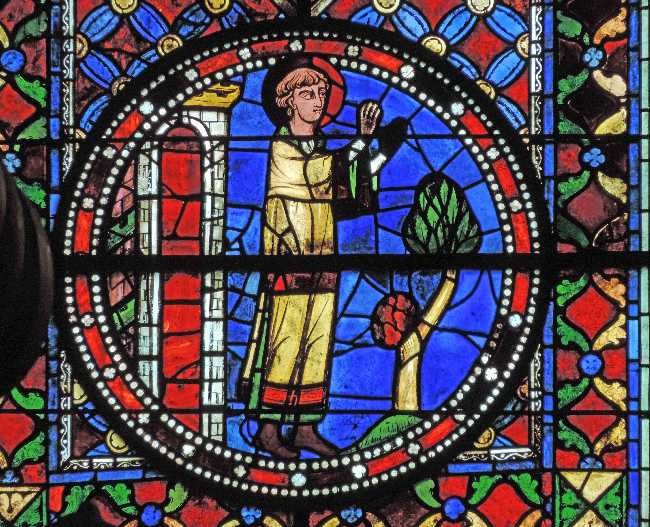
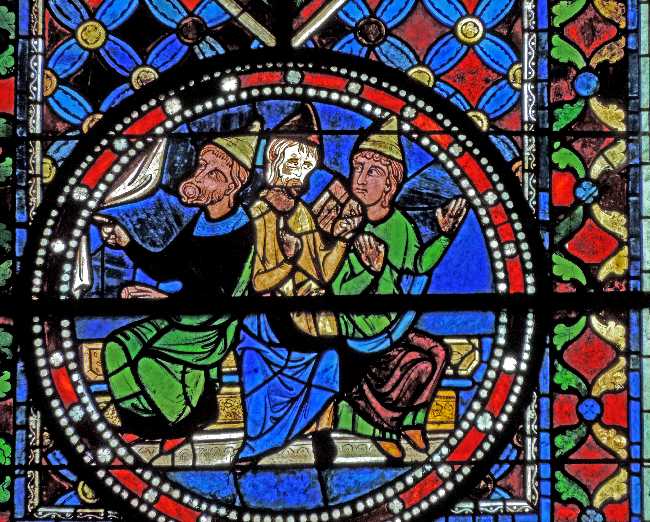
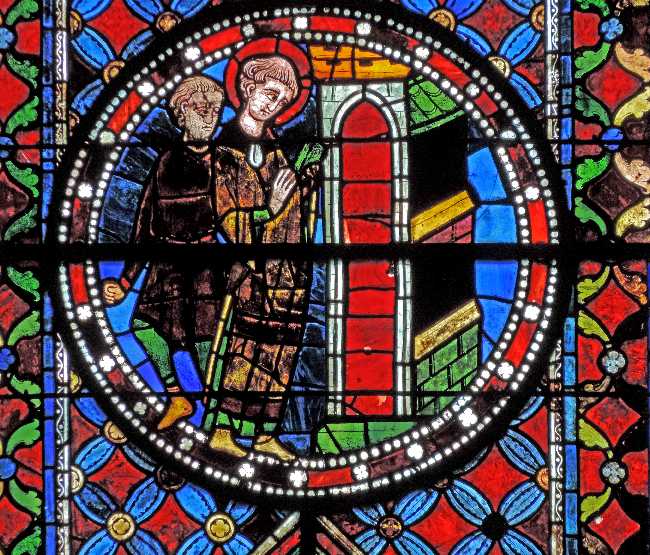
There are a sizeable number of stained-glass windows retelling the story of the life of Stephen as told in the Acts of the Apostles as well as later events including the finding of his bones in the 5th century.
Photos credits. All photos are from Painton Cowen.
There are a sizeable number of stained-glass windows retelling the story of the life of Stephen as told in the Acts of the Apostles as well as later events including the finding of his bones in the 5th century.
Photos credits. All photos are from Painton Cowen.

Stephen
entrusted with his mission. Laon Cathedral east window c.1210-1215. http://www.therosewindow.com/pilot/Laon/images/w1-01-576A2181.JPG

Stephen
preaching. Sens Cathedral. window 102 1230-1240. http://www.therosewindow.com/pilot/Sens/Images/w102-A1-DSCN4184.JPG

The
listeners to the preaching. Sens Cathedral. window 102 [Note the Jews’ hats] http://www.therosewindow.com/pilot/Sens/Images/w102-B1-DSCN4186.JPG

Stephen
is denounced. Sens Cathedral. window 102. http://www.therosewindow.com/pilot/Sens/Images/w102-A2-DSCN4183.JPG

Stephen
is imprisoned. Sens Cathedral window 102. http://www.therosewindow.com/pilot/Sens/Images/w102-B2-DSCN4187.JPG

Stephen before the High Priest. Normandy 1230-1240
now in Victoria & Albert.
Museum no. C.20-1980 [(PW) 2003]

Stephen before the Sanhedrin. Laon Cathedral. East
window 1210-1215. http://www.therosewindow.com/pilot/Laon/images/w1-03-576A2184.JPG

Stephen before the Sanhedrin. Chartres Cathedral.
window 13. http://www.therosewindow.com/pilot/Chartres/images/w13-6-CAN_1879.JPG

Stephen
led out to be stoned. Chartres window 13. http://www.therosewindow.com/pilot/Chartres/images/w13-8-CAN_1887.JPG

Stephen led out to be stoned. Laon Cathedral. East
window. http://www.therosewindow.com/pilot/Laon/images/w1-04-576A2183.JPG
The stoning of St. Stephen appears in so many windows that I chose only two.

The
stoning of Stephen. Bourges Cathedral. window 10. c.1210-1215. http://www.therosewindow.com/pilot/Bourges/images/w10-9-576A2439.JPG

The stoning of Stephen. Chartres Cathedral window 13.
http://www.therosewindow.com/pilot/Chartres/images/w13-10-IMG_10670.JPG

Saul, seated, is given a garment from Stephen after the stoning. Sens Cathedral
http://www.therosewindow.com/pilot/Sens/Images/w102-A3-DSCN4182.JPG

Stephen is buried. Chartres Cathedral. 13th century. http://www.therosewindow.com/pilot/Chartres/images/w13-11-CAN_1881.JPG

The priest Lucian leads Bishop John to the relics of Stephen. Auxerre Cathedral. 13the century.
http://www.therosewindow.com/pilot/Auxerre/images/w16-1-IMG_9583.JPG

The relics are reburied with dignity and a healing rain falls on December 26, 415 CE. Bourges Cathedral. Window 15. 1210-1215.
http://www.therosewindow.com/pilot/Bourges/images/w15_8-30949.jpg
I have made no attempt to include all the different windows about the miracles associated with the relics of St. Stephen, many of which are included in the Legenda Aurea. Bishop Augustine of Hippo included miracles associated with St. Stephen in the City of God, Book XXII, Chapter VIII. Of Miracles Which Were Wrought that the World Might Believe in Christ, and Which Have Not Ceased Since the World Believed. https://sourcebooks.fordham.edu/source/augustine-cityofgod-22-9-10.asp
As I wrote above the relics of Stephen were moved several times including within the area of Jerusalem, Jerusalem to Constantinople and then to Rome. There is a set of six windows telling the story of the removal of the shrine of Stephen's relics from Jerusalem to Constantinople in the Cathedral of Our Lady, Chartres.

The shrine of St. Stephen is put aboard a boat. Chartres window 13. http://www.therosewindow.com/pilot/Chartres/images/w13-15_10086.jpg

The devil lets loose a storm. http://www.therosewindow.com/pilot/Chartres/images/w13-18-CAN_1902.JPG

The boat arrives safely thought the devil is still lurking above.
http://www.therosewindow.com/pilot/Chartres/images/w13-19-CAN_1905.JPG

A crowd of the sick and infirm welcome the arrival of the boat with the relics of St, Stephen with their apparent miraculous ability to cure.
http://www.therosewindow.com/pilot/Chartres/images/w13-20-CAN_1897.JPG

The relics are removed from the boat.
http://www.therosewindow.com/pilot/Chartres/images/w13-21-CAN_1904.JPG

The reception of the relics at Constantinople.
http://www.therosewindow.com/pilot/Chartres/images/w13-22-CAN_1899.JPG


Orders were given to transfer the relics of St. Stephen from Constantinople to Rome in order to save the Emperor Valentinian II's daughter Eudoxia. Bourges Cathedral. Window 15, panels 17 and 18.
http://www.therosewindow.com/pilot/Bourges/images/w15_17-30962b.jpg
http://www.therosewindow.com/pilot/Bourges/images/w15_18-30955b.jpg

The remains of St. Stephen moved to Rome.
Bourges Cathedral. window 15, panel 19.
http://www.therosewindow.com/pilot/Bourges/images/w15_19-30954.jpg

http://www.therosewindow.com/pilot/Bourges/images/w15_18-30955b.jpg
The remains of St. Stephen moved to Rome.
Bourges Cathedral. window 15, panel 19.
http://www.therosewindow.com/pilot/Bourges/images/w15_19-30954.jpg
The top panel of the St. Stephen window at Chartres Cathedral, window 13 shows two angels carrying the soul of Stephen to heaven. This ends this blog for today.
Stephen's soul carried to heaven by angels. Chartres Cathedral. window 13, top panel.
http://www.therosewindow.com/pilot/Chartres/images/w13-23_10076.jpg