Showing posts with label Chartres. Show all posts

Friday, December 27, 2019

December 26. St Stephen's Day 2019


December 27, Christmas Day 3

December 26, St. Stephen’s Day

This is the one day of the year when we should all hear the carol about the Bohemian king Wenceslas (who was a 10th-century duke of Bohemia) who braved the bitter winter weather and snow to distribute alms to the poor. The carol was written by the hymn writer that should be familiar to all Episcopalians since there are so many of his hymns and translations of hymns which appear in the 1982 Hymnal.  John Mason Neale wrote the lyrics before 1853 and they were set to “Tempus adest floridum” that was first published in the 1582 collections of songs, Piae Cantiones.
            
Good King Wenceslas looked out, on the Feast of Stephen,
When the snow lay round about, deep and crisp and even;
Brightly shone the moon that night, tho' the frost was cruel,
When a poor man came in sight, gath'ring winter fuel.         
The last two lines:
            Therefore, Christian men, be sure, wealth or rank possessing,
Ye who now will bless the poor, shall yourselves find blessing.

I had many errands to do yesterday, and never once did I hear the carol, though it was played often before Christmas Day.

St. Stephen

The story of Saint Stephen is written in the Acts of the Apostles 6.1-8.2.  He probably lived from 5-34 BCE. Though Stephen is a Greek name, he was Jewish given his lengthy speech to the Sanhedrin defending himself and outlining how Jesus fulfilled the Law, not subvert it. The Apostles gained so many converts, Jews and Greek-speaking Jews, that they were failing in their duty to care for the poor, especially widows of the Greek-speaking converts. The Acts of the Apostles states that the Hellenists (Greek-speaking Jews) complained that their widows were being slighted in favor of the Hebrew/Aramaic speaking widows. The Apostles decided to delegate what they saw as a burdensome, less worthy duty to deacons so that the Apostles could continue their preaching. 

The Apostles laid hands upon, ordained, seven deacons, of which Stephen was the first. Stephen was a very zealous and effective preacher and teacher among the Greek-speaking Jews especially in the three synagogues of the Freemen, and Cyrenians, and Alexandrians.  It is not known which group of freed Jewish slaves and their descendants that comprised the Freemen. The most likely group were the Jews who were taken as slaves by General Pompey when he conquered Judea in 63 BCE who had returned to Judea.  Cyrene was a Greek-speaking town in what is now Libya. Alexandria is in Egypt. The Jews in these synagogues were exceedingly angry with Stephen. They hauled him before the Sanhedrin. They claimed that Stephen’s teachings were blasphemous against Moses and God. The trial was not completed before the inflamed mob grabbed Stephen and stoned him to death. Stephen was the first martyr to the faith that did not even have the name Christian yet.

I think there are two points in Stephen’s summary of the history of the Jews from Abraham that cause the rage of the mob to become murderous. First, he quoted Isaiah 66.1 against the Temple in Jerusalem. Acts 7.48. “Yet the Most High does not dwell in houses made by human hands; as the prophet says,”

Isaiah 66.1. Thus says the Lord: Heaven is my throne and the earth is my footstool;
what is the house that you would build for me, and what is my resting place?

Then Stephen immediately called his listeners. Acts 7.51-52a “‘You stiff-necked people, uncircumcised in heart and ears, you are for ever opposing the Holy Spirit, just as your ancestors used to do.  Which of the prophets did your ancestors not persecute?’”

Saul of Tarsus witnessed Stephen’s stoning death. After Stephen’s death, his body was buried by “Godly men” who deeply mourned his death. No place of death or burial is mentioned in the Acts of the Apostles.

The Feast of St. Stephen on December 26th is from a wholly different story, and that is the finding of the bones of St. Stephen.  In 415 CE, a priest named Lucian supposedly dreamt of the locations of Stephen’s bones at Beit Jimal, an ancient small town west of Jerusalem. The relics were taken in procession to the Church of Hagia Sion on 26 December 415. Thus, the Feast of St. Stephen is the day his relics were carried (translated) to the Church of Hagia Sion, a Byzantine church built on Mount Zion. This church built by Emperor Constantine was destroyed during the Persian or Sasanian conquest of Jerusalem in 614. Stephen’s bones did not find rest but were moved several more times and distributed to many places before being taken to Rome by Pope Pelagius II (pope from 579-590). They were entombed with those of St. Lawrence in the Basilica di San Lorenzo fuori le Mura. The Golden Legend tells that the body of St. Law(u)rence rolled over so that there was enough room in the sepulcher to place the bones of St. Stephen.

There are a sizeable number of stained-glass windows retelling the story of the life of Stephen as told in the Acts of the Apostles as well as later events including the finding of his bones in the 5th century.

Photos credits. All photos are from Painton Cowen. 


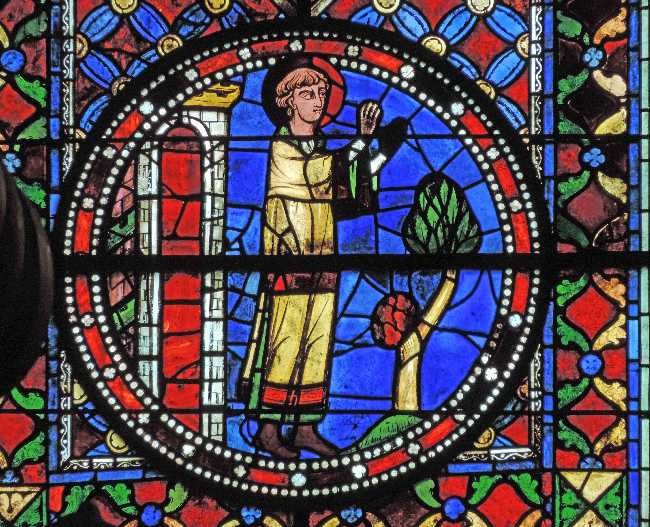
Stephen entrusted with his mission. Laon Cathedral east window c.1210-1215. http://www.therosewindow.com/pilot/Laon/images/w1-01-576A2181.JPG

Stephen preaching. Sens Cathedral. window 102 1230-1240. http://www.therosewindow.com/pilot/Sens/Images/w102-A1-DSCN4184.JPG

The listeners to the preaching. Sens Cathedral. window 102 [Note the Jews’ hats] http://www.therosewindow.com/pilot/Sens/Images/w102-B1-DSCN4186.JPG

Stephen is denounced. Sens Cathedral. window 102. http://www.therosewindow.com/pilot/Sens/Images/w102-A2-DSCN4183.JPG

Stephen is imprisoned. Sens Cathedral window 102.  http://www.therosewindow.com/pilot/Sens/Images/w102-B2-DSCN4187.JPG

Stephen before the High Priest. Normandy 1230-1240 now in Victoria & Albert. 
Museum no. C.20-1980 [(PW) 2003]

Stephen before the Sanhedrin. Laon Cathedral. East window 1210-1215.  http://www.therosewindow.com/pilot/Laon/images/w1-03-576A2184.JPG

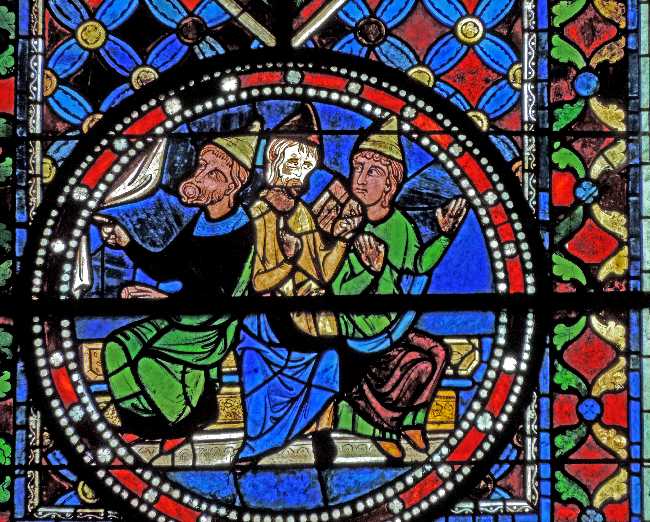
Stephen before the Sanhedrin. Chartres Cathedral. window 13. http://www.therosewindow.com/pilot/Chartres/images/w13-6-CAN_1879.JPG

Stephen led out to be stoned. Chartres window 13. http://www.therosewindow.com/pilot/Chartres/images/w13-8-CAN_1887.JPG

Stephen led out to be stoned. Laon Cathedral. East window. http://www.therosewindow.com/pilot/Laon/images/w1-04-576A2183.JPG

The stoning of St. Stephen appears in so many windows that I chose only two.
The stoning of Stephen. Bourges Cathedral. window 10. c.1210-1215. http://www.therosewindow.com/pilot/Bourges/images/w10-9-576A2439.JPG

The stoning of Stephen. Chartres Cathedral window 13. http://www.therosewindow.com/pilot/Chartres/images/w13-10-IMG_10670.JPG

Saul, seated, is given a garment from Stephen after the stoning. Sens Cathedral
http://www.therosewindow.com/pilot/Sens/Images/w102-A3-DSCN4182.JPG

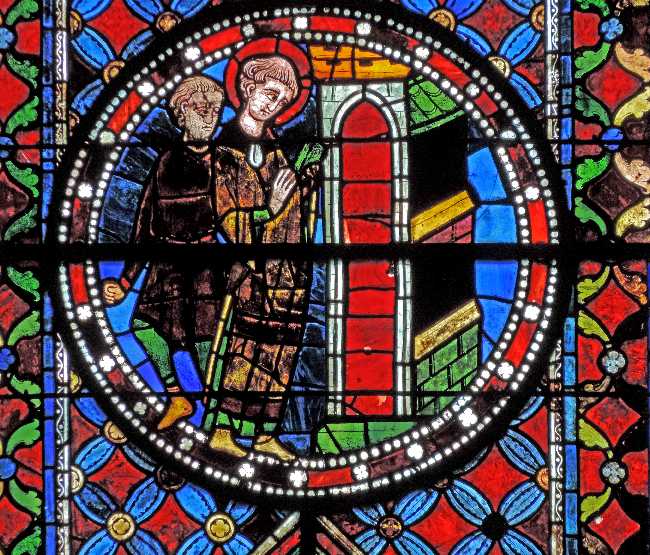
Stephen is buried. Chartres Cathedral. 13th century. http://www.therosewindow.com/pilot/Chartres/images/w13-11-CAN_1881.JPG

 
The priest Lucian leads Bishop John to the relics of Stephen. Auxerre Cathedral. 13the century.
http://www.therosewindow.com/pilot/Auxerre/images/w16-1-IMG_9583.JPG

The relics are reburied with dignity and a healing rain falls on December 26, 415 CE.  Bourges Cathedral. Window 15. 1210-1215. 
http://www.therosewindow.com/pilot/Bourges/images/w15_8-30949.jpg

I have made no attempt to include all the different windows about the miracles associated with the relics of St. Stephen, many of which are included in the Legenda Aurea. Bishop Augustine of Hippo included miracles associated with St. Stephen in the City of God, Book XXII, Chapter VIII. Of Miracles Which Were Wrought that the World Might Believe in Christ, and Which Have Not Ceased Since the World Believedhttps://sourcebooks.fordham.edu/source/augustine-cityofgod-22-9-10.asp

As I wrote above the relics of Stephen were moved several times including within the area of Jerusalem, Jerusalem to Constantinople and then to Rome.  There is a set of six windows telling the story of the removal of the shrine of Stephen's relics from Jerusalem to Constantinople in the Cathedral of Our Lady, Chartres.

The shrine of St. Stephen is put aboard a boat.  Chartres window 13.  http://www.therosewindow.com/pilot/Chartres/images/w13-15_10086.jpg

The devil lets loose a storm. http://www.therosewindow.com/pilot/Chartres/images/w13-18-CAN_1902.JPG

The boat arrives safely thought the devil is still lurking above. 
http://www.therosewindow.com/pilot/Chartres/images/w13-19-CAN_1905.JPG

A crowd of the sick and infirm welcome the arrival of the boat with the relics of St, Stephen with their apparent miraculous ability to cure.
http://www.therosewindow.com/pilot/Chartres/images/w13-20-CAN_1897.JPG

The relics are removed from the boat. 
http://www.therosewindow.com/pilot/Chartres/images/w13-21-CAN_1904.JPG

The reception of the relics at Constantinople.
http://www.therosewindow.com/pilot/Chartres/images/w13-22-CAN_1899.JPG

   
Orders were given to transfer the relics of St. Stephen from Constantinople to Rome in order to save the Emperor Valentinian II's daughter Eudoxia. Bourges Cathedral. Window 15, panels 17 and 18.
http://www.therosewindow.com/pilot/Bourges/images/w15_17-30962b.jpg
http://www.therosewindow.com/pilot/Bourges/images/w15_18-30955b.jpg


The remains of St. Stephen moved to Rome.
Bourges Cathedral. window 15, panel 19.
http://www.therosewindow.com/pilot/Bourges/images/w15_19-30954.jpg

The top panel of the St. Stephen window at Chartres Cathedral, window 13 shows two angels carrying the soul of Stephen to heaven.  This ends this blog for today.

Stephen's soul carried to heaven by angels. Chartres Cathedral. window 13, top panel.
http://www.therosewindow.com/pilot/Chartres/images/w13-23_10076.jpg


Wednesday, August 19, 2015

Pictures of Saint-Denis and Chartres

       I have mentioned a number of famous churches with Jesse Tree stained glass windows thus far.  It helps me to look at a Jesse Tree window in the milieu of the church where it is located.  Looking back at the previous blogs, I noticed that I did not included any exterior or interior pictures  of two of the most famous churches that have Jesse Trees:  Cathedral of St. Denis in St.Denis part of Paris and Cathedral of Our Lady in Chartres.  To remedy this deficiency, I will post pictures for each church from <www.mappinggothic.org>.


 West end entrance to St.Denis.  The Gothic west end was begun under the direction of Abbot Suger about 1135.  The next phase of Gothic rebuilding was the choir from about 1140-1144.  Originally the church had two towers.  The northern tower and spire were disassembled after lightening struck the tower in 1837, and then a storm the same year further damaged the tower.
<http://mappinggothic.org/archmap/media/buildings/001000/1182/images/100/1182_00658_w.jpg>

The ambulatory was built around the choir for the use of pilgrims.  It made use of most of the design elements that are considered Gothic such as the pointed arch, ribbed vaulting, clustered columns from which the ribbed vaulting spring, radiating chapels and large windows.  The ambulatory has external buttresses supporting the walls but these are not flying buttresses. 
<http://mappinggothic.org/archmap/media/buildings/001000/1182/images/1300/1182_00133_w.jpg>

     The Cathedral of Our Lady at Chartres was begun about 1194 and mostly finished in 1250, a very short time span for building a cathedral.  It has remained over the years a model for Gothic architecture.
Drawing of the west front of the Cathedral of Our Lady in Chartres.
<http://mappinggothic.org/archmap/media/buildings/001000/1107/images/300/1107_00123_w.jpg>

 Another view of the west front of Chartres Cathedral with its three portals
<http://mappinggothic.org/archmap/media/buildings/001000/1107/images/100/1107_00349_w.jpg>

North side of nave looking toward the west.  The dominant color of the stained glass windows is blue.
<http://mappinggothic.org/archmap/media/buildings/001000/1107/images/700/1107_00213_w.jpg>

Sunday, August 9, 2015

Seven Doves in Stained Glass windows: Part III b.


Some twenty years ago, I was asked to take on and develop a program about a Jesse Tree for children for the First Sunday of Advent at the Chapel of the Cross where I attend church.  All I could remember was the Jesse Tree window of Chartres and a brief mention of the ceiling at St. Michael’s Church at Hildesheim that was destroyed during World War II.  It was a dim haze of memory, at best.  It has been a long time since I took the required History of Art course with the 1st edition of H. W. Hanson’s weighty book, that eventually became a classroom staple for decades.  But at least it was a place to start learning more about the great variety of Jesse Trees.

Even now, the single lancet Jesse Tree at the west end of the Cathédrale Notre-Dame de Chartres is the prototypical Jesse Tree that most students of introductory art history classes know. The window was made shortly after 1144.  The Chartres Jesse Tree window is a copy of the one ordered by Abbot Suger for the Abbey Church of Saint-Denis in Paris that was completed on or before 1144 when the rebuilt choir of St. Denis was dedicated. [The famous art historian, the late Erwin Panofsky, dated the rise of Gothic architecture to the reconstruction of the east end of St. Denis.]  The Chartres’ Jesse Tree window is probably the oldest complete Jesse Tree window still existing.

The Jesse Tree window of Chartres Cathedral. Delaport window #1
Photo credit: Painton Cowen. 
http://therosewindow.com/pilot/Chartres/images/w49-whole-comp.jpg 

Detail of top of Jesse Tree window with Jesus Christ seated in majesty, surrounded by seven doves.
http://therosewindow.com/pilot/Chartres/images/w49-7+8-70367.JPG

The model of the St. Denis-style or Dionysian Jesse Tree window is a vertical glass cartoon for a single lancet window containing two sets of stories: the family tree of Jesus and the prophesies of the Messiah.  In the bottom center panel, Jesse, the father of David, is reclining.  From his abdomen arises a tree trunk or vine.  In the center glass panels, one above another, are two and often more kings of Israel.  The center panels are an abbreviated ancestry of Jesus from Jesse and Kings David and Solomon.  In the earliest windows such as Chartres, the kings are not identified with iconographic symbols such as a harp or scepter.  The two kings above Jesse are assumed to the David and Solomon followed by one or more generic kings.  Above the kings is the Virgin Mary seated at the feet of Jesus Christ.  Jesus Christ is enthroned in majesty at the top of the panel.  The figures are seated in static frontal poses frequently with hands grasping the Jesse Tree vine. 

On each side of the seven central glass panels in the Chartres window are representations of 14 Old Testament prophets, priests, and leaders: Nahum, Hosea, Samuel, Amos, Ezekiel, Micah, Zechariah, Joel, Moses, Balaam, Isaiah, Daniel, Habakkuk, and Sophonias or Zephaniah.  The prophets in the Jesse Tree window at Chartres hold scrolls or banderoles with names. I wish I knew why the Jesse window at Chartres does name its prophets but the windows that generally followed the design of Chartres have only generic unidentified prophets.  It is only a century latter that sometimes there are names or identifying verses for the prophets.  Unfortunately without names or banderoles or standardized symbols, there is no way to identify the prophets portrayed in the windows found in France and England.  The numbers of prophets, patriarchs and the addition of one or two sibyls are all variable in the surviving 12th and 13th century windows and fragments.  The Jesse Tree is topped with seven doves surrounding the head of Christ.  This vertical design is sometimes given the shorthand name of “Norman stack.”

The stained glass windows of the Royal Abbey of Saint Denis were made beginning about 1140 or so, probably only a few years before the Jesse window at Chartres.  At that time, St. Denis was a small town north of Paris.  Now St. Denis is part of Paris.

The Jesse window and the other stained glass windows at St.Denis were made under the direction and supervision of Abbot Suger.  They were costly to make and considered quite precious by Abbot Suger.  He wrote:

“Since their marvelous workmanship and the cost of the sapphire and painted glass makes these windows very valuable, we appointed a master craftsman for their protection and maintenance, just as we also appointed a skilled goldsmith for the gold and silver ornaments.”[1]

The windows at the Abby Church of St. Denis managed to survive the Wars of Religion (1562-1598) that ended with the coronation of Henri IV and the issuing of the Edict of Nantes that granted substantial political and social rights to the Huguenots.  The Jesse window and the other windows even survived the French Revolution when many windows within the reach of the stones and other objects wielded by mobs were destroyed.  In 1799, Alexandre Lenoir removed about 140 stained glass panels that were to be exhibited at his Musée des Monuments Français in Paris.  Only 31 panels were returned to the choir of the church.  The rest were smashed in an oxcart accident or sold by Lenoir privately to collectors.[2]  

Fortunately some of Suger’s windows were sketched in 1794-5 by Charles Percier, including the reclining Jesse.  He had been commissioned to design the installation of some royal tombs removed during the French Revolution.  He apparently sketched the windows at part of his plans for the design.  His sketches are the only surviving record of the scheme of the gothic windows.  The sketches were helpful when restoration of the window began in 1847 by Viollet-le-Duc.  Fortunately for the Jesse Tree window, some of the center panels were not lost or broken.  Pieces of the border survived and so the complete window could be pieced together with original and reproduced glass in the 19th century. 

The restored Jesse Tree window at St. Denis.
Photo credits: Painton Cowen
http://www.therosewindow.com/pilot/France-O-Z/images/st-denis-8186-sc.jpg

Detail of top of Jesse window at St. Denis 1140 and 19th century.
http://www.therosewindow.com/pilot/France-O-Z/images/st-denis-8185-sc.jpg


The man whose vision and direction authorized the renovation of St. Denis and the production of its stained glass was Abbot Suger.  He was probably a native of St. Denis, born about 1081.  He was given at age 9 or 10 (oblate) to the monastic community at St. Denis. He had short stature and small size. The humble origins and size of Suger have been summed up in Simon Chevre d’Or’s epitaph:

Small of body and family, constrained by two fold smallness,
He refused in his smallness to be a small man.[3]

Suger was educated and served in a number of capacities at the monastery and at the courts of Louis VI and VII, Kings of France.  He led an active life travelling to Normandy and south France and Rome as part of his duties.  When elected Abbot in 1121-1122, he was on another trip to Rome.  Abbot Suger was a shrewd administrator and astute financier permitting the extensive rebuilding of St. Denis.  At his death, in 1151, Abbot Suger left behind substantial written material including a memoir of his administration.  It was probably written between 1144 and 1148.  Unfortunately the Jesse Tree window of St.-Denis only gets a passing mention by Suger in Ch. 34 of On what was done under his Administration (Liber de rebus in administratione sua gestis).  He wrote, “we caused to be painted, by the exquisite hands of many masters from different regions, a splendid variety of new windows, both below and above; from that first one which begins the series with the Tree of Jesse in the chevet [east end] church to that which is installed above the principal door in the church's entrance.”[4]  At St. Denis, the Jesse window is still located at the east end of the church in the ambulatory chapel.[5]

Abbot Suger sought to bring the light of God into the darkened world to uplift the congregation.  A substantial amount of literature exists about the Abbot bringing Pseudo-Dionysian thinking about the mystical power of light to the church,  especially the church of St. Denis.[6]  The poem in his book of administration written for the front doors of the church summarize this thinking.

All you who seek to honor (or extoll) these doors,
Marvel not at the gold and expense but at the
craftsmanship of the work.
The noble work is bright, but, being nobly bright, the work
Should brighten the minds, allowing them to travel through the lights
To the true light, where Christ is the true door.[7]

The place of origin of the “master(s)” who made the Jesse Tree window has been the subject of speculation though at least some came from Burgundy since scholars have suggested a stylistic similarity between the figures in the Jesse Tree window and illuminated manuscripts made at the Cistercian Abbey of Cîteaux.  No one answer though has been found to be satisfactory since some scholars point to similarities in sculpture more than illuminated manuscripts as the source for the windows.  The matter is still one of scholarly investigation. [8]

The single lancet Jesse Tree window has surviving examples in France before it crossed the channel to England.  The earliest Jesse Tree window at Canterbury Cathedral bears much similarity to the window at St. Denis and Chartres.


[1] Abbot Suger: On what was done in his Administration. Medieval Sourcebook. Fordham Univerisity. http://legacy.fordham.edu/halsall/source/sugar.html
[2] Hayward, Jane. "Stained Glass at Saint-Denis." In Sumner McK. Crosby, ed. The Royal Abbey of St.-Denis in the Time of Abbot Suger (1122-1151). New York: Metropolitan Museum of Art (1981): 61-71.
[3] John F. Benton. Introduction: Suger’s Life and Personality in Paula L. Gerson, ed. Abbot Suger and Saint-Denis: A Symposium (1986) Metropolitan Museum of Art. New York: Harry N. Abrams.
[4] Abbot Suger: On what was done in his Administration. Medieval Sourcebook.  Chapter 34. Fordham University. http://legacy.fordham.edu/halsall/source/sugar.html
[5] http://www.medart.pitt.edu/image/France/St-denis/windows/Jesse/SDenis-JesseW-Frame.html
[6] For example: Michael Cothren. Picturing the Celestial City: The Medieval Stained Glass of Beauvais Cathedral. (2006), Princeton: Princeton University Press, pp.71-96.  Also Madeline Caviness. "Suger's Glass at Saint-Denis: The State of Research," in  Paula L Gerson, ed. Abbot Suger and Saint-Denis: A Symposium, (1986) New York: The Metropolitan Museum of Art. pp.257-72.
[7] Abbot Suger: On what was done in his Administration. Medieval Sourcebook. Fordham University. chapter 27 http://legacy.fordham.edu/halsall/source/sugar.html
[8] Nolan, Kathleen, "Arts of the Medieval Cathedrals: Studies on Architecture, Stained Glass, and Sculpture in Honor of Anne Prache" (2015). Books by Hollins Faculty. Book 78.
http://digitalcommons.hollins.edu/facbooks/78.   Madeline H. Caviness. Suger’s Glass at St. Denis: The State of Research in Paula L. Gerson, ed. Abbot Suger and Saint-Denis: A Symposium. The Metropolitan Museum of Art, New York. (1986) New York: Henry N. Abrams, Inc.  Hayward, Jane. "Stained Glass at Saint-Denis." In Sumner Crosby, ed. The Royal Abbey of St.-Denis in the Time of Abbot Suger (1122-1151). New York: Metropolitan Museum of Art (1981): 61-71.

Saturday, August 8, 2015

Was a Jesse Tree always called a Jesse Tree?


I keep using the terms Jesse Tree or Tree of Jesse but that is a relatively recent term for the pictorial design of the ancestors of Jesus.  The term “Jesse Tree” seems to date from the 18th century.  The earlier term is Stirps Jesse from Stirps Jesse virgam produxit virgaque florem et super hunc florem requiescit spiritus almus, a response chanted during the Mass for the Feast of the Nativity of Mary on September 8.  (Translation: The Tree brought forth a twig and the twig a flower that rests on nourishing spirit.)  This tied together the idea of Mary, the mother of Jesus, as the symbolic rod of Jesse, and Jesus, her son, as the flower.  Note the play upon virgo (virgin) and virga (rod or stem). 

Another version of the Stirps Jesse:

Stirps Jesse florigeram germinavit virgulam et in flore spiritus quiescit paraclitus.

Fructum profert virgule per quem vivunt secula.
Stirpis ex davitice virga dicta mistice que sic et sic floruit et que florem protulit.

Virga jesse virgo est Dei mater flos filius eius est cuius Pater, huic flori preter morem edito canunt chori sanctorum ex debito:

Laus et jubilation potestas cum imperiosit sine termino celorum domino.


Freely translated:

The stump of Jesse will bring forth a twig bearing a flower, and the flowers lives in the Spirit.

The Holy Spirit mystically brings forth the twig called the Virgin from all the living generations of the lineage of David.

Who so, who flourished, who brought forth the flower?  The shoot of Jesse is the Virgin, the Mother of God.  The flower is her son, Son of the Father.

Because this flower was born in an unusual way, we duly sing the chorus of the saints.

Praise and jubilation to the Lord of heaven whose power is without end.


This trope is attributed to Bishop Fulbert of Chartres (Bishop from1006-1029).  The trope was added to Benedicamus Domino (Let us bless the Lord).  YouTube has several chanted versions of these lines. Just search “Stirps Jesse.”  I will come back to Bishop Fulbert who championed the Feast of the Nativity of the Virgin Mary and was important in the development of Mariology during the Middle Ages.


Notre Dame de la Belle Verriere, Chartres Cathedral
Delaport Window #14. dated to abt. 1150. Mostly original except for face of the Virgin.
Photo credit: Holly Hayes
http://static.sacred-destinations.com/img/620/gohistoric_1026_z.jpg