Showing posts with label Solomon. Show all posts

Tuesday, August 25, 2015

Cathedral of Saint Maurice, Angers, Maine-et-Loire (in the former province of Anjou), France

     The city of Angers used to be the capital of the province of Anjou ruled by counts.  In 1127, Count Geoffrey married the widowed daughter of Henry I of England, Matilda or Maud.  Their eldest son, Henry became Henry II of England, the first of the Plantagenet kings.   As such it was the home town of the Plantagenet family though Geoffrey was born and buried at nearby Le Mans.

     The story of the building of the cathedral at Angers is one that is familiar by now.  A Romanesque cathedral was built to replace a much smaller church.  The new Romanesque church burnt to the ground in 1032.  The same bishop, Hubert de Vendome, who oversaw the consecration of the Romanesque church started the rebuilding some time after the fire.  This Romanesque church was consecrated in 1096.  The retrofitting and rebuilding of the church in the Gothic style was begun under Bishop Ulger (1123-1149) and continued under his successor Bishop Normand de Doue (1149-1153). The west front of the Cathedral retains the darker stone of the older Romanesque church at the lowest level.  The church took centuries to build and the tower and west facade were not finished until the Renaissance.

West front of the Cathedral of Saint Maurice, Angers, France.  The present cathedral was built over centuries.  The darker stone at the lowest level is from the 12th century Romanesque church.
<http://static.panoramio.com/photos/large/66376237.jpg>

The lower half of the walls of the nave are retained from the Romanesque church as can be seen in the photograph below.  The walls were reinforced to accommodate the weight of the vaulting covering the nave,  The cathedral has no aisles.  So the windows that light the church are at the clerestory level.
Looking east down the nave.  The lower half of the wall was retained from the older Romanesque church and retrofitted.
<http://mappinggothic.org/archmap/media/buildings/001000/1212/images/700/1212_00084_w.jpg>

West entrance to the cathedral with large tympanum of Jesus Christ seated in majesty and the four living creatures that surround the throne of God in the Revelation of John. It was St. Jerome writing about 398 in his preface to the Commentary on Matthew when he established the symbols as we know them today: Matthew-human or angel, Mark-lion, Luke-ox, and John-eagle. This entrance was built about 1170-1180.
The remains of the Gothic porch as be seen in the stone work but it was demolished in 1807.
http://mappinggothic.org/archmap/media/buildings/001000/1212/images/1300/1212_00031_w.jpg

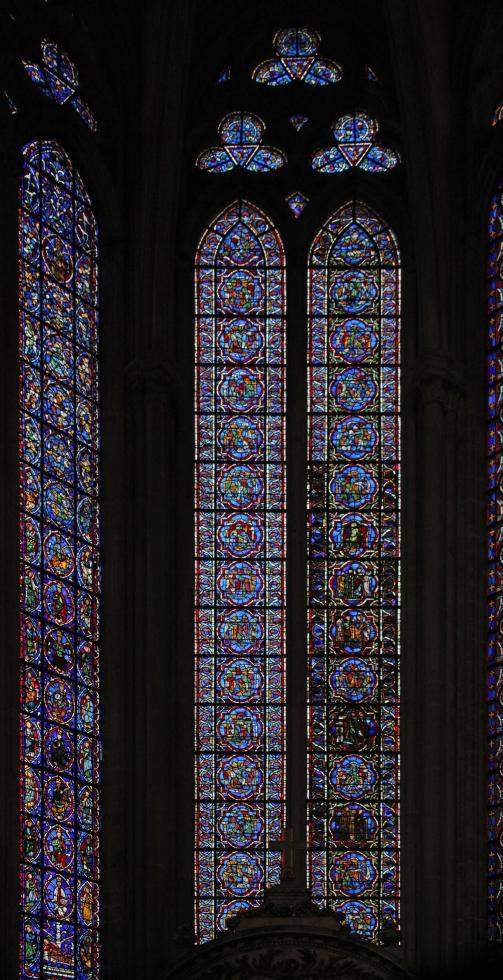
     The rounded east end of the choir, the chevet, required that the old town wall be demolished to make room for the addition.  This addition was built in the period of 1225-1240 during the time Guillaume de Beaumont was bishop (1202-1240).  The windows in the chevet are doubled lancet windows with an oculus at the top.  The Cathedral of Saint Maurice had the advantage of many other cathedrals in that it was much less dependent of money from pilgrims to make additions and repairs. Boulanger is her analysis of the windows at Saint Maurice notes a unity of iconography among the windows that is not found in many other cathedrals dependent on the money from pilgrims and gifts from wealthy donors.  Donors did pay for window repairs, and this is documented by the inclusion of the arms of the donor family in the window.  David King noted in a article for Vidimus, "The St John the Baptist window in the choir, for example, given in the thirteenth century by Richard de Tosny, the cathedral treasurer, was restored in the early fourteenth century by the Chaumont family, whose arms were inserted in the border"
The east end of St. Maurice with the double windows and oculus at the top.
<http://www.patrimoine-histoire.fr/images/Patrimoine/Angers/eStMaurice/AngCSM61.JPG>

Bay 103 on the north side of the choir has a Jesse Tree window on the right and the martyrdom of St. Lawrence on the left.
<http://www.patrimoine-histoire.fr/images/Patrimoine/Angers/eStMaurice/g/AngCSM_103.JPG>
   
     The Jesse Tree window in Bay 103 at Angers is a few years earlier that the Jesse Tree window of Saint-Chapelle in Paris. The window at the Cathedral of Saint Maurice has more in common with lower clerestory window at Cathedral of St. Julian at Le Mans or the Cathedral of St. Stephen in Auxerre, than with Sainte-Chapelle. The Jesse window is one of eleven windows in the chevet that were glazed during the period 1230-1235 that still exist.  A couple of the lost windows are known from fragments.  So the chevet retains a remarkably complete set of 13th century windows made with a  cohesive scheme, the lives of saintz and Virgin Mary.  The windows did undergo restoration at a intervals and some of the windows have been moved.  Replacements for lost windows has continued into the 20th century to repair damage done during the bombardment of World War II.  Unfortunately the Jesse Tree window at Angers needs cleaning since the detail has been lost and many of the colors have been muted by grime and perhaps glass corrosion.

The whole Jesse Tree window in Bay 103.
Photo credit for Jesse Tree windows (unless noted): Painton Cowen
<http://www.therosewindow.com/pilot/Angers/images/Angers_w103a_whole-w.jpg>

Jesus Christ seated with seven doves.  Right hand is held in blessing. In his left hand is a blue book There are two flanking unidentified prophets. 
Photo credit: Dr. Stuart Whatling
<http://www.medievalart.org.uk/Angers/Bay_103b/jpeg_800/Angers_Bay_103b_Jesse_Tree_Panel_08.jpg>

 Crowned Virgin Mary with a scepter in her right hand.  She is flanked by two prophets and a knelling figure who is presumably the donor of the window.  The prophet on the right is wearing a blue cap. 
<http://www.therosewindow.com/pilot/Angers/images/w103l-AB-7-IMG_6989.JPG>

Unidentified King of Judah.  He is flanked by two unidentified prophets.  Note that the head of the right prophet is a obvious later repair.
<http://www.therosewindow.com/pilot/Angers/images/w103l-AB-6-IMG_6990.JPG>

Unindentified King of Judah holding a scepter in the left hand, flanked with two prophets.  Note that the prophet on the right is wearing a pointed Jew's cap in green.
< http://www.therosewindow.com/pilot/Angers/images/w103l-AB-5-IMG_6991.JPG>

King playing a vielle on his left shoulder.  He is flanked by two prophets. Note that the prophet on the king's right is the same design as the prophet on king's right immediately above.
<http://www.therosewindow.com/pilot/Angers/images/w103l-AB-4-IMG_6992.JPG> 

 First King of Judah above King David.  In the usual iconography, this is King Solomon. The king is holding a scepter in his right hand.  He is flanked by a prophet on his left hand that is wearing a pointed green Jew's cap, as is the prophet to Virgin Mary's left.
 <http://www.therosewindow.com/pilot/Angers/images/w103l-AB-3-IMG_6993.JPG>

King David playing a celtic style harp. The prophet on the right is the same as the prophet above on the right of Virgin Mary.  He is wearing a blue cap.  The prophet on the left is wearing a pointed Jew's cap in red.
<http://www.therosewindow.com/pilot/Angers/images/w103l-AB-2-IMG_6994.JPG .>

Reposing Jesse as seen through a protective grille.  There is a large white trunk arising from the body of Jesse.  He is flanked by two prophets that appear to be much later replacements.
Photo credit: Dr. Stuart Whatling
<http://www.medievalart.org.uk/Angers/Bay_103b/jpeg_800/Angers_Bay_103b_Jesse_Tree_Panel_01.jpg>

   Hopefully the reader has noticed the standardization of the colors for the background on the Jesse Tree windows.  It is either red or blue or a mixture with red or blue glass within the mandorlas that surround the figures and blue or red outside the mandorlas.

      There is the beginning of a standardized iconography that allows the identification of at least two of the kings that come after Jesse, namely Kings David and Solomon.  King David is playing a harp, a symbols associated with the David as the composer of the Psalms.  Also there are frequent references to harps or lyres in the story of David including his playing the harp for King Saul (1 Samuel 16.23) and  the frequent references to music made to honor God including harps (and lyres). 

     It is curious then that the king above David, Solomon, is only holding a scepter and not playing an instrument as is the third king above Jesse. Solomon is associated with the composition of the Song of Solomon or Song of Songs.  The stained glass windows of Saint Maurice suffered through periods of neglect followed by restoration and repair, and again long centuries of neglect or destruction as a result of iconoclasm or war.  It is possible to speculate that during one of these restorations the panel of Solomon and a generic king of Judah with scepter were reversed.  This argument is not sustained because the same pattern of king with scepter for King Solomon and generic king playing an instrument appears in another stained glass window from the same period.  The very large Jesse Tree window at the Cathedral of Our Lady at Amiens, Picardy, France, was made about 1260, with restoration in the 19th and 20th centuries.  In this window, King David is playing the bowed lyra, a Byzantine instrument.  The king above him and therefore Solomon is a sceptered king and the third generic king is playing a vielle in his lap.  So perhaps the iconography of Solomon also playing a instrument was not yet firm.

     Another curious feature of the Jesse Tree window at Angers is the kneeling donor dressed in purple petitioning the Blessed Virgin Mary. This seems to be the first Jesse Tree window that has survived in which the donor is shown beseeching the Virgin Mary. This portrayal of Mary as the Mediatrix between humans and Jesus was being developed as part of the cult of Mary.  A Jesse Tree window at the  choir of Cathedral of Saint Julien in Le Mans also has a kneeling donor.  This kneeling donor is placed in the choir Jesse window next to the reclining Jesse in the Le Mans cathedral.  Thus it seems as though the donor's petition isaddressed to all the figures above, not just the Virgin Mary.

    This Jesse Tree window has two blue capped prophets and three prophets wearing the pilleus cornutus,or Jew's hat ordered at the Fourth Lateran Council of 1215.  Similarly hatted prophets are found in the Jesse Tree window of the relatively near Cathedral of Saint Julian at LeMans.

References:

Karine Boulanger, Les Vitraux de la cathédrale d’Angers,((2010) Paris, Comité des travaux historiques et scientifiques (CTHS), coll. « Corpus Vitrearum-France », vol. III,

David King. Angers Cathedral Vidimus Vol. 48. February 2011.  < http://vidimus.org/issues/issue-48/feature>

Angers, Cathédrale Saint-Maurice.  Mapping Gothic Europe <http://mappinggothic.org/building/1212>

Monuments historique: Inventaire général du patrimoine culturel <http://www.culture.gouv.fr/public/mistral/merimee_fr?ACTION=CHERCHER&FIELD_1=REF&VALUE_1=PA00108866>

Tuesday, August 18, 2015

Cathedral of St. Peter and St. Paul, Troyes, Champagne-Ardennes, France


Cathedral of St. Peter and St. Paul, Troyes, Champagne-Ardennes, France
<http://mappinggothic.org/archmap/media/buildings/001000/1055/images/300/1055_00006_w.jpg> 

Nave of the Cathedral of St. Peter and St. Paul, Troyes, Champagne-Ardennes, France.
<http://mappinggothic.org/archmap/media/buildings/001000/1055/images/700/1055_00036_w.jpg>


     The Cathedral of St. Peter and St. Paul is located in Troyes, a town in the Aube district of the Champagne-Ardennes region of France.  The town dates to the Roman occupation of Gaul.  The town grew up on the Seine River where a number of roads came together including the Via Agrippa.  At the end of the Roman Empire, the town went by the name of Tricassium, from which the name of Troyes was derived.  Apparently the town was the seat of a Roman Catholic bishop from the 4th century.  Several churches must have existed on the site of the present cathedral.  A Romanesque cathedral was significantly damaged by fire in 1188, but it must not have been completely destroyed because it was about 20 years later before the Gothic rebuilding began in approximately 1208.

     Money and politics seem to have played a significant part is the progress or lack thereof in the building of the church.  Thibaut III (also known as Theobold III), Count of Champagne, ruled from 1197 to 1201, his death.  He seems to have been instrumental in raising money and enthusiasm for the Fourth Crusade called by Pope Innocent III in 1198.  Money and debts accrued to pay for the crusades removed money that would have been available for building and rebuilding churches.  The lack of money impeded the economy of Champagne and left no money for patronage of major building projects such as the Cathedral.  After the death of Thibaut III, his wife, Blanche of Navarre, ruled as regent for 21 years since her son, Thibaut IV, was born shortly after his father's death.  The rule by Blanche of Navarre and the succession of her son, Thibaut or Theobold IV, was contested during almost the whole period of the regency.

     Given the chronic problem with money, the Troyes Cathedral was built incrementally. The east of the cathedral was built first including the choir, apse, radiating chapels and transepts. The hand of two master masons has be identified in the choir area built up to about 1220. Then the upper portions of the choir were built by a third master mason. Building was disrupted by two additional problems.  The first was a "whirlwind" that destroyed the upper portions of the choir in 1228.  Contemporary accounts say the church was destroyed, but subsequent rebuilding proved that there was major damage but not total destruction. 

     The following year, in 1229, a league of barons allied to King Louis VIII of France waged a war against the Count of Champagne, Thibaut IV (also known as King Theobold I of Navarre).  This conflict may have caused further damage to the newly rebuilt church or, at the very least, drained away even more money that could have been used for the construction and glazing of the cathedral. This war further depleted the economy of Champagne. The romantic version of the conflict explains the war as jealously over a supposed relationship between Thibaut IV and his cousin Blanche of Castile who was the widow of Louis VIII.  Blanche was a granddaughter of Eleanor of Aquitaine and Thibaut IV was a great-grandson of Eleanor of Aquitaine.  The more likely conflict was money and the status of Jews living in Champagne. Champagne had a prosperous Jewish population.  Blanche of Navarre as regent had gained significant income from higher taxes imposed on the Jews in return for guarantees of safety.  This money then helped her finance the conflicts over succession of her son as Count of Champagne.  Once Thibaut IV became King of Navarre on the death of his uncle-in-law, his position politically and financially became too strong to assail.  He did have to buy-off other claimants to the rule of Champagne.
  
     Because of the step-wise completion of the Troyes Cathedral, construction apparently halted after the eastern half of the church was built for some years.  Construction of the remainder of the cathedral including nave and towers continued through the 16th century.

     The Tree of Jesse stained glass window was made in all likelihood for the eastern axial chapel of the Cathedral of Troyes during the first period of construction. The window seems to have been made in two periods, before the storm on 1228 and then after the storm of 1228.  The older glass is dated to about 1210, and the younger glass is dated to 1230-1240.  It  is possible that some of the glass was damaged during the collapse of the choir and took some time before repairs would have been put in place.  The reconstruction of the choir took precedence over continued glazing of the windows.  

     As noted in the earlier blog, the present Jesse Tree window at Troyes lacks the prophets usually found in Jesse Tree windows. The window is mostly a 19th century reconstruction that is located in a position of the north side of the choir in Bay 31 or window # nXVII.  The central Jesse Tree is white with white mandorlas with red accents surrounding the four kings, Jesse, Virgin Mary and Christ Jesus.


Jesse Tree window from Troyes Cathedral Bay 31. Jesse is reclining on his bed.  King David is playing a vielle.  King Solomon is writing in a book or playing a cithara.  Two generic kings of Judah hold scepters. Virgin Mary is holding a palm branch. Christ is enthroned with his right hand in blessing and holding a book, the Gospels.
<https://upload.wikimedia.org/wikipedia/commons/thumb/7/70/Vitrail_Arbre_de_Jess%C3%A9_Cath%C3%A9drale_Troyes_200208_1.jpg/44px-Vitrail_Arbre_de_Jess%C3%A9_Cath%C3%A9drale_Troyes_200208_1.jpg>

Original 13th century glass in Jesse Tree window at Troyes as estimated by Professor Elizabeth Pastan.

     In the above image, Professor Elizabeth Pastan has drawn the putative original glass in the current mostly 19th century Jesse Tree window.  Parts of  Jesse, and Kings David and Solomon are original as is part of the generic king of Judah, the Virgin Mary and Christ Jesus in majesty.

     If art historians are correct that the Tree of Jesse window was located in the easternmost chapel of the Cathedral.   Apparently the window was removed in 1779 when a sculpture, Descent from The Cross, was installed in the chapel.  Further, some panes of what appeared to be Jesse Tree stained glass was noted among the broken glass found after the French Revolution.  According to written descriptions from the first half of the 19th century, some of the Jesse Tree panels appeared within other windows of the ambulatory chapels.  In 1869, the restored Jesse Tree window was returned to the choir, without the prophets.  The Victoria and Albert Museum acquired ten Jesse Tree prophet panels in 1881.
  
    As far back as 1958, the art historian Dr. Louis Grodecki noted that the prophet panels in the Victoria and Albert Museum in London "were of similar quality as that of the stained glass of Troyes."  Professor Pastan in her examination of the window at Troyes and the prophet panels in London, makes a solid argument that the Victoria and Albert museum panels are the missing panels from Troyes.  Her argument has four points: (1) the height of the Troyes' king panels and the height of the prophet panels are the same (2) the width of the original king panel plus two prophet panels fit the size of the axial chapel windows with space for leading and armatures, (3) the glass at the Victoria and Albert and the Cathedral of Troyes have similar pitting and aging, and (4) the palette of colors used in the prophet panels and the Troyes Cathedral Jesse window are the same.  The color palette is quite different from the 19th century restoration glass.
     
     Professor Pastan comments that there are some problems with her attribution.  There are differences in the styles and size of the prophet figures, between the prophet figures and the kings, differences in the handling of the cloth, drawing the hair, and the standing positions of the prophets (contrapposto positions). 

    Yet the relationship between the prophet panels is confirmed by the fact that two sets of the figures use the some cartoon but are mirror images.  These are Daniel and Aaron, and Abacus (Habakkuk) and Helpas (Helias or Isaiah).

Top of the Jesse Tree lancet window at Troyes Cathedral.  Detail of Christ Jesus and St. Mary holding a palm branch.
<https://upload.wikimedia.org/wikipedia/commons/thumb/c/cb/Vitrail_Arbre_de_Jess%C3%A9_Cath%C3%A9drale_Troyes_200208_5.jpg/77px-Vitrail_Arbre_de_Jess%C3%A9_Cath%C3%A9drale_Troyes_200208_5.jpg>

Generic king of Judah.  This is a 19th century replacement panel
<https://upload.wikimedia.org/wikipedia/commons/thumb/3/36/Vitrail_Arbre_de_Jess%C3%A9_Cath%C3%A9drale_Troyes_200208_4.jpg/120px-Vitrail_Arbre_de_Jess%C3%A9_Cath%C3%A9drale_Troyes_200208_4.jpg>

Generic king of Judah.  Note that head is a different scale than the remainder of the body.  The head is a 19th century replacement.
<https://upload.wikimedia.org/wikipedia/commons/thumb/7/74/Vitrail_Arbre_de_Jess%C3%A9_Cath%C3%A9drale_Troyes_200208_3.jpg/120px-Vitrail_Arbre_de_Jess%C3%A9_Cath%C3%A9drale_Troyes_200208_3.jpg>

King Solomon playing a cithara, a type of lyre.
<http://www.therosewindow.com/pilot/Troyes%20cathedral/images/w31-3-CAN_2209.jpg>

King David bowing a waisted vielle.  Mostly 13th century glass.
<https://upload.wikimedia.org/wikipedia/commons/thumb/9/96/Vitrail_Arbre_de_Jess%C3%A9_Cath%C3%A9drale_Troyes_200208_2.jpg/120px-Vitrail_Arbre_de_Jess%C3%A9_Cath%C3%A9drale_Troyes_200208_2.jpg>


Two panels of prophets from the Victoria and Albert.  Note that Aaron (top) and Daniel (bottom) are mirror images.  The Daniel is spelled backward, undoubtedly an error that occurred when the cartoon was reversed. 
<http://media.vam.ac.uk/media/thira/collection_images/2009CE/2009CE2261_jpg_o.jpg
http://media.vam.ac.uk/media/thira/collection_images/2009CE/2009CE2267_jpg_o.jpg>


Helpas or Helias, the Vulgate Latin for Isaiah (top) and Abacus or Habakkuk (bottom) are mirror images though it would appear that two different persons did the painting because of differences in handling of the material of the clothing, hands and other details in the panels.
<http://media.vam.ac.uk/media/thira/collection_images/2009CE/2009CE2266_jpg_ds.jpg
http://media.vam.ac.uk/media/thira/collection_images/2009CE/2009CE2263_jpg_o.jpg>


Two unidentified prophets with similar, mirror image designs.  These prophets are not identified though the designs of the window and border are virtually identical to the other panels.  Again, it appears as though the figures are painted by two different persons because of the difference in details. 
<http://media.vam.ac.uk/media/thira/collection_images/2009CE/2009CE2273_jpg_o.jpg
http://media.vam.ac.uk/media/thira/collection_images/2009CE/2009CE2272_jpg_o.jpg>

Professor Pastan noted that Ezekiel, spelled EXECHYEL, in the stained glass panel, is stylistically similar to Daniel, Helpas (Helias or Isaiah), Habakkuk and Aaron.  There are enough differences though to suggest that they were made by different artisans and perhaps at somewhat different time periods.
<http://media.vam.ac.uk/media/thira/collection_images/2006AJ/2006AJ8028_jpg_o.jpg>


Another two prophets that appear to be reversed cartoons.  The top prophet is unidentified and the bottom panel is Moise or Moses.
<http://media.vam.ac.uk/media/thira/collection_images/2009CE/2009CE2268_jpg_o.jpg
http://media.vam.ac.uk/media/thira/collection_images/2009CE/2009CE2270_jpg_o.jpg>


 Roboan is Rehoboam who was King of Judah and not a prophet (though the "prophet" part of the scroll is a repaired section).  Professor Pastan pointed out the fact that this panel appears to be most similar to King David and Solomon from the remaining Jesse tree  when  comparing size and style of the figure.  None of the other prophets are quite the same the Rehoboam.
<http://media.vam.ac.uk/media/thira/collection_images/2009CE/2009CE2264_jpg_o.jpg>


      A reconstructed Jesse Tree might look a bit like the picture below if panels at the Victoria and Albert Museum could be married to the Jesse Tree panels at the Cathedral in Troyes.

I cannot say that I am very pleased with this effort.  So I will probably try again with the reconstruction.  So, if you come back again, you will probably see another picture.

References

Brad Lenz, Henrietta Miers, Crystal Terry, and Hanna Wiegers. "Troyes Cathedral: Stained Glass, God instructing Adam & Eve at the Tree of Knowledge. "<http://sites.duke.edu/medren290stainedglass/> (August 16, 2015)

Elizabeth C. Pastan. "Fit for a Count: The Twelfth-Century Stained Glass Panels from Troyes." Speculum, (Apr. 1989) 64: 338-372.

Elizabeth C. Pastan. "'And He Shall Gather Together the Dispersed' The Tree of Jesse at Troyes Cathedral." Gesta (1998) 37(2):232-239.

Charles T. Little, "Membra Disjecta: More Early Stained Glass from Troyes Cathedral, Gesta, (1981). 20(1) 119-39.

Stephen Murray, Building Troyes Cathedral: The Late Gothic Campaigns, (1987) Indianapolis: University of Indiana,  He also has a  very useful website: Mapping Gothic France.  <http://mappinggothic.org/>

Louis Grodecki. "De 1200 a 1260".in  Marcel Aubert, Le vitrail francais (1958) Paris: Editions 2 monde.

V & A: Search the collections

Painton Cowen, Therosewindow.com 
http://www.therosewindow.com/pilot/Troyes%20cathedral/images/w31-CAN_2209-11.JPG (Augsut 15, 17, 18, 2015).


Thursday, August 13, 2015

The Single Lancet Jesse Tree Window in France: Reading a Jesse Tree Window, Part B

     The spectacular French Gothic Cathedral of Our Lady, Amiens, Picardy, France was started about 1220, a rebuilding project because of destruction of earlier cathedrals by fire.  The oldest stained glass at Amiens is dated to about 1250 or 1260 with subsequent restorations in the 19th and 20th century.   The cathedral of Amiens was damaged during the Wars of Religions, as well as,  from bombs and missiles during World War I.  The Jesse Tree window is in the choir of the church (Cowen window # 14). The Amiens Jesse window is notable for its use of blue.  Of the 17 main divisions within the window, nine date from the 13th century or are substantially from the 13th century.  The Jesse figure at the bottom is a replacement. Eight of the kings are originals including David and Solomon.  At the top of the window, only the figure of the Virgin Mary is original glass (Painton Cowen).


Note that Jesse window is to the left of this picture.
Photo credit for all pictures:  Painton Cowen
<http://www.therosewindow.com/pilot/Amiens/w14-Frame.htm>

Whole Jesse Tree window.  Details below. 
<http://www.therosewindow.com/pilot/Amiens/images/w14-whole-IMG_2741-44.jpg>

Generic King of Judah holding a scepter.
<http://www.therosewindow.com/pilot/Amiens/images/w14-level6.jpg>

Generic King of Judah with left hand holding to Jesse Tree vine
<http://www.therosewindow.com/pilot/Amiens/images/w14-level5.jpg>

Generic King of Judah playing a vielle.  This is the panel above King Solomon.
<http://www.therosewindow.com/pilot/Amiens/images/w14-level4.jpg>

King Solomon above King David.  Solomon is holding a scepter. He appears to be virtually identical of the other kings holding scepters.
<http://www.therosewindow.com/pilot/Amiens/images/w14-level3.jpg>

King David playing seven string lyre with what appears to be a bow.  Lyres were instruments from the Byzantine Empire that were probably introduced to France as a result of the Crusades. 
<http://www.therosewindow.com/pilot/Amiens/images/w14-level2.jpg>
   
     The Jesse Tree window at Amiens is tall, though the window at St. Chapelle may be taller.  In addition to Jesse, Kings David and Solomon, Virgin May and Jesus Christ in majesty, there were eleven kings of Judah portrayed.  All are posed frontally.  Many of the prophets hold banderoles but there are no identifying names.
    
     After a fire in 1188 destroyed the Romanesque Cathedral of  St. Peter and St. Paul in Troyes, Champagne, France, a new cathedral was started about 1208.  The first part of the cathedral to be built in the new Gothic style was the choir.  It is in the choir, that the Jesse Tree window resides.  The stained glass windows in the choir date from about 1220, older than the Jesse Tree at Amiens.  Like Amiens, it is a substantially blue window. In the 21st century, about half the window is original glass and about half is 19th century replacement glass.  Again the figures are frontally posed. In the Troyes' Jesse Window, King David plays the vielle, an acknowledgement of his authorship of the Psalms.  The King Solomon above David is writing in a book. (French art historians identify the rectangular object in Solomon's hands as a cithar, a form of lyre.  Both would succeed as symbols for Solomon, either as a author of wisdom literature or as the writer of the Song of Solomon). Much of the Jesse Tree is a grape vine with many clusters of grapes, especially appropriate for Champagne, France.  Another interesting design feature of the genealogy of Jesus in the Troyes window is the lack of prophets or other Old Testament references except for the kings. (More about this when I write about Troyes Cathedral.)

The whole Jesse Tree, 13th and 19th century at Troyes, Cathedral of Sts. Peter and Paul.
Photo Credit for all photos: Painton Cowen
<http://www.therosewindow.com/pilot/Troyes%20cathedral/images/w31-CAN_2208.JPG>

 Virgin Mary, seated and holding a lily in her right hand.
 <http://www.therosewindow.com/pilot/Troyes%20cathedral/images/w31-6-CAN_2208.jpg>

King Solomon writing in a book.
<http://www.therosewindow.com/pilot/Troyes%20cathedral/images/w31-3-CAN_2209.jpg >

King David playing a waisted vielle.
<http://www.therosewindow.com/pilot/Troyes%20cathedral/images/w31-2-CAN_2209-11.jpg>


The Single Lancet Jesse Tree Window in France: Reading a Jesse Tree Window, Part A

        I am beginning my review of single lancet French Jesse Tree windows of the 12th century onward by discussing how one reads a Jesse Tree window from both bottom up ( Jesse, King David, other kings) and top down, (Christ in Majesty, the Blessed Virgin Mary, then kings). Often people think of Jesse Tree windows as picture books for the illiterate. But that cannot be the full story since many were made of abbey churches and other places where the most likely persons to see the windows were at least modestly literate monks and clergy. Jesse windows are often found at the east end of churches and in Lady's Chapels where clergy would have been the primary viewers of the window.

     I have mentioned that the persons in a Jesse Tree, whether illuminated or in glass, can be identified by position within the tree, accompanying symbols, accompanying scrolls or banderoles, or even names written near the figure. In the Jesse Tree window, the identification of the persons in the window is important for the understanding of the window. 


     The bottom panel or panels of a Jesse Tree from the 12th through the mid-15th century is/are occupied by the recumbent or reclining Jesse, asleep usually in a bed. This sleeping Jesse evokes both Jacob’s dream and the sleep of Adam when Eve was formed from Adam’s rib by God as told in the second creation story, Genesis 2.4-24. Sometimes the “rib of Adam” image is enforced with the tree or vine growing from Jesse’s side. At other times, the tree seems to grow from the loins of Jesse, a reference to the "begats" of Matthew 1. When Jesse is lying down, Jesse sometimes appears in multiple panels, especially as the Jesse Trees enlarged from single lancet windows to multiple panels. After the mid-15th century through the 16th century, Jesse is found nodding off while seated on a chair or throne. The seated Jesse is revived in the 19th century neo-gothic windows.

     The prophets and patriarchs were most often identified by scrolls or banderoles, and something by names. If there is no written identification of the prophet or patriarch or other ancient person, their identification is nearly impossible since the order and placement of prophets, patriarchs, and priests of the Old Testament was never standardized in Jesse Tree windows.

     Symbols identified the kings. In the Angers cathedral  window (Cathedral of St. Maurice, Angers, Maine-et-Loire, France)  the king of Judah above Jesse is playing a harp, and therefore is King David. The second king of Judah above Jesse is holding a scepter. This is sometimes the symbol for King Solomon. The third king of Judah above Jesse is playing a vielle, the symbol often associated but not always with Solomon since he was considered the author of the Song of Solomon or Canticum Canticorum
.  Other iconographic symbols include a book or a model of a church for the Temple of Jerusalem. [Note: French scholars seem to refer to the bowed waisted instrument that I call a vielle, a "rote."  Rote refers to a Welsh stringed instrument that looks more like a lyre.]

     As an aside, the vielle was a bowed 5-string instrument that may or may not have been waisted like a violin. The vielle is related to the rebec and Bysantine lyras that have three to five strings. Among the descendats of the vielle is the viol and later the violin and viola. Vielles were played either on the shoulder or the lap.


Since the 13th century Jesse Tree window of the Cathedral of St. Maurice, Angers, France is hard to see because of  corrosion of the glass, I have included details of the upper panels from Christ in majesty at the top to David with harp at the bottom, skipping one unidentified King of Judah.  Note King David with harp, King Solomon with scepter and unidentified king with unwaisted vielle
Photo credit: Dr. Stuart Whatling
<http://www.medievalart.org.uk/Angers/angers_default.htm >

     Scholars have noted that the window panels at Angers have been rearranged in the past. And thus, it is quite possible that the order of the kings were re-arranged in error at some point. Boulanger in her study of the windows at Angers states that the Jesse Tree window in the choir is one of eleven windows made between 1230-35. The cathedral was wealthy enough that it did not depend on secular donors, and thus there was great unity in the style and iconography of the windows. (Karine Boulanger. Les vitraux de la cathédrale d'Angers (2010) Paris: CTHS.) The stained glass at Angers cathedral, made in the 12th, 13th, and 15th centuries, suffered through periods of restoration and repair and long centuries of neglect. It is possible to speculate that during one of these 
restorations the panel of Solomon and a generic king of Judah with scepter were reversed. (David King. Angers Cathedral, Vidimus 48 (Feb. 2011, <http://vidimus.org/issues/issue-48/feature/>
).

     There is a similar orders of the kings of Judah in the Jesse Tree window of Amiens Cathedral.