Showing posts with label Jesus. Show all posts

Thursday, August 27, 2015

Typology and Typological Reasoning


     The early Christian church searched the Old Testament to find passages that seem to tell of the Messiah, or Redeemer or Savior or King that was to come to Israel’s aid.  And, by analogy, come to the aid of the early Church during periods of persecution and suppression.  The Christian church was not always persecuted during its first 300 or so years.  It was generally tolerated except when it came into conflict with the Roman understanding of social order that required sacrifice to the Emperor, though exemption certificates could at times be purchased.

     Pliny the Younger wrote to Emperor Trajan about 112 asking how to deal with Christians while he was governor of Bithynia, now Turkey.  Pliny found though Christians seemed to lead good lives, Christianity was a “bad and…extravagant superstition… spread like a contagion, not only into cities and towns, but into country villages also, which yet there is reason to hope may be stopped and corrected.”  Trajan’s reply has been preserved.  In part it reads, “These people are not to be sought for; but if they be accused and convicted, they are to be punished; but with this caution, that he who denies himself to be a Christian, and makes it plain that he is not so by supplicating to our gods, although he had been so formerly, may be allowed pardon, upon his repentance.” (Pliny the Younger, Epistolae, Book X, letters 97, 98.)  
  
      The periods of persecution and suppression of the early Church include:
1.     Nero (c. 64-68)
2.     Domitian (r. 81-96).
3.     Trajan (112-117). Christianity is outlawed but Christians are not sought out.
4.     Marcus Aurelius (r. 161-180).
5.     Septimus Severus (202-210).
6.     Decius (250-251). Christians are actively sought out by requiring public sacrifice
7.     Valerian (257-59).
8.     Maximinus the Thracian (235-38).
9.     Aurelian (r. 270–275).
10.  Diocletian and Galerius (303-324).

     The persecution of Christians in the western Roman Empire ended for the most part in 313 with the Edict of Milan. This document has never been found and the only reference to it in the Eusebius of Caesarea’s Historia Ecclesiastica Book X  (Chapter 5, Copies of Imperial Laws <http://www.ccel.org/ccel/schaff/npnf201.iii.xvi.v.html> ) written about the end of persecution:

When I, Constantine Augustus, and I, Licinius Augustus, came under favorable auspices to Milan and took under consideration everything which pertained to the common good and prosperity, we resolved among other things, or rather first of all, to make such decrees as seemed in many respects for the benefit of every one; namely, such as should preserve reverence and piety toward the deity. We resolved, that is, to grant both to the Christians and to all men freedom to follow the religion which they choose, that whatever heavenly divinity exists may be propitious to us and to all that live under our government.

     Given this long history of intermittent suppression, it is not surprising that the early Church turned to the Hebrew scriptures to look for hope to sustain their faith in Jesus Christ.  They turned to the books of the Former Prophets (the books of Joshua, Judges, Samuel, and Kings).  Samuel was included in many Jesse Tree renderings because Samuel spoke of the attributes of a king chosen by God, who would rule over Israel; protect the people from their enemies (1 Samuel 10:1) and who would be attentive to the will of God.  (1 Samuel 16)  

     They read the books of the four major prophets, Isaiah, Jeremiah, Daniel  and Ezekiel.  All twelve of the minor prophets show up in Jesse Tree because of references to the hoped for Messiah.  Habakkuk is the most common.  Habakkuk’s prayer was popular with its vision of the wrath, majesty, and salvation of the Lord (Habakkuk 3:1-19).   Zechariah, another popular figure, is included because of the passage:  “Lo, your king comes to you; triumphant and victorious is he” (Zechariah 9:9). Another popular passage was from Hosea 14:57: “I will be like the dew to Israel; he shall blossom like the lily, he shall strike root like the forests of Lebanon...they shall flourish as a garden, they shall blossom like the vine...”

     Looking at the Old Testament as a text that foreshadows the conception, birth, life, death, and resurrection of Jesus and even Mary, his mother, is not a mindset that is easily understood in the 21st century.  But it was the usual method of thinking about the Old Testament in the Middle Ages and is called typology. 

     The medieval monks, clergy, and artists looked for passages in the Old Testament that they thought prefigured events in the life of Jesus and of his mother, Mary.  For example, the darkness at noon on the day of Jesus’ crucifixion was foreseen in a passage from Amos.  “I will make the sun go down at noon, and darken the earth in broad daylight.”  (Amos 8:9)  Using typology, one looks at one event as revealing or prefiguring another event, or an event as fulfilling a prior prophesy, or two or more events that imitate each other in some providential way.  Here are several more example of typological reasoning to help illustrate this way of thinking. The birth of Eve from the rib of Adam was seen as paralleling the birth of the Church from the pierced side of Jesus.  Cain leading Abel out to slay him was a foreshadowing of the Jews taking Jesus from Jerusalem before the crucifixion.  The laughter of Ham was seen as prefiguring the taunting of Jesus during his passion. During the Middle Ages, it was assumed that every event in the Old Testament had its typological twin in the New Testament.

     This sort of reasoning becomes especially prominent in the Biblia Pauperum, a type of picture Bible that became popular toward the end of the medieval period. 
This page from a Biblia Pauperum shows the three frequently linked stories of the sacrifice of Isaac by Abraham, the raising up of the bronze serpent by Moses and the Passion of Our Lord.

British Library King’s 5 f.17. Netherland (The Hugue) 1405.
<http://molcat1.bl.uk/IllImages/Kslides/big/K018/K018704.jpg>

The text on the left reads:
According to Genesis xii, 7-18, when Abraham has raised his sword to sacrifice his son, an angel of the Lord prevented him from heaven, saying: 'Do not lift your hand against the boy'. Abraham signifies the heavenly Father, who sacrificed his son (that is, Christ) on the cross for us all, so that in this way he might give an indication of the Father's love.         
  
The text on the right reads:   
 According to Numbers xxi, 4-8, when the Lord wanted to free from serpents the people whom the serpents had bitten he instructed Moses to make a brass serpent and hang upon it a stake so that whoever looked at it would be rid of serpents. The serpent hung up and stared at by the people signifies Christ on the cross, which every believing person who wishes to be rid of the serpent (that is, the devil) should gaze upon.

David’s scroll reads, “They have pierced my hands and my feet.”  The scroll from Isaiah is a reference to Isaiah 53 and the suffering servant poem.  The verse on the scroll is a paraphrase, “He was sacrificed because he himself wished it, and he bore our sins.”  Job’s scroll is Job 40.20 in the Vulgate, “Canst thou draw out the leviathan with a hook?”  The bottom line reads, “The suffering of Christ snatches us from the gloomy abyss.” Habakkuk’s scroll says, “There are horns on his hands: there his strength is hidden.”(Habakkuk 3.4b.) 

     To illustrate the linking of Old Testament with New Testament, here are a few examples of well-known Old Testament writings that tell the coming of Jesus, his life, and his death, and medieval understanding of Mary:  (A few of these references will be familiar to most modern Christians since they are read during Advent and sometimes at other times of the liturgical church year.)

1.               Numbers 17.24a. “I see him, but not now; I behold him, but not near-a star shall come out of Jacob and a scepter shall rise out of Israel …”  This passage was linked to the genealogy in Luke 3.24: “son of Jacob, son of Isaac, son of Abraham, son of Terah, son of Nahor…”  This is also linked with references to the star of the Magi.(Matthew 2.2)

2.               Isaiah 40.3: “A voice of one calling in the wilderness, ‘Prepare the way for the Lord; make straight in the desert a highway for our God.’”  The verse from Isaiah prefigured the preaching of John the Baptist as written in Matthew 3, Mark 1.1-14, Luke 3.2-18, John 1.6-18.

3.               Isaiah 53.3.  “He was despised and rejected by mankind, a man of suffering, and familiar with pain.”  This verse foretold the rejection of Jesus by his family, especially the verse John 7.5:  “For not even his brothers believed in him.”

4.               Jeremiah 31. 15:  “Rachel is weeping for her children; she refuses to be comforted for her children, because they are no more.”  This verse foreshadowed the killing of infant and toddler children by Herod as written in Matthew 2.18.

5.               Hosea 11.1: “Out of Egypt I call my son.”  This verse was thought to refer to the time that Jesus and his family spent in Egypt as told in Matthew.

6.               Micah 5.2:  “O Bethlehem of Ephrathah, who are one of the little clans of Judah, from you shall come forth for me one who is to rule in Israel.”  Even the gospel writers understood this verse to foretell the birthplace of Jesus Christ though Mark seemed to assume that Jesus was born in Nazareth.

7.               Zechariah 13.6: “And if anyone asks them, ‘What are these wounds on your chest?’ the answer will be ‘The wounds I received in the house of my friends.’”  The verse from Zechariah was linked to John 19.1: “Then Pilate took Jesus and had him flogged.  A similar verse is found in Matthew 20.19 when Jesus foretells the manner of his death.  “[T]hey will hand him over to the Gentiles to be mocked and flogged and crucified; and on the third day he will be raised.”  Luke 23.22 is part of the speech that Pontius Pilate has with the crowd.  “A third time he said to them, ‘Why, what evil has he done? I have found in him no ground for the sentence of death; I will therefore have him flogged and then release him.’”

8.               Malachi 4.5: “I will send the prophet Elijah to you before that great and dreadful day of the Lord comes.”  Jesus identified John as Elijah in Matthew 11.14: “and if you are willing to accept it, he is Elijah who is to come.

9.               Noah was saved by the wooden ark (Genesis 6-9) as the wood of the cross became an instrument of salvation with the death and resurrection of Jesus.

10.            Isaac carried the wood for his sacrifice (Genesis 22:6), and this was linked symbolically with Jesus carrying his cross before the crucifixion (John 19:17).

11.            The passage from Zechariah 12.10, “when they look on me whom they have pierced, they shall mourn for him, as one mourns for an only child, and weep bitterly over him, as one weeps over a firstborn.”  This foreshadowed the piercing of the side of the crucified Jesus as described in John 19.34, “one of the soldiers pierced his side with a spear, and at once there came out blood and water.”

12.            Linked to this verse about blood and water are two sacraments of the Christian church, namely the Eucharist and Baptism.

13.            Jacob’s ladder (Genesis 28:10-22) has been linked to both Jesus and Mary.  Jacob’s ladder was seen as the reference in Jesus’ comment to his newly recruited disciples that they will see “the angels of God ascending and descending upon the Son of Man” (John 1.51).  The ladder image is again referenced both to Jesus’ statement that he was the gate or door to heaven (John 10:9), and the Ascension. 

14.            In addition, the ladder symbol is applied to Mary as the ladder or mediator between earth and her Son, the Redeemer. 

15.            The ladder was a symbol for the Cross when applied to humankind.  Believers will ascend by the ladder of faith to Heaven and unbelievers will descend to Hell.

16.            Joseph being thrown into the pit in the wilderness by his brothers (Genesis 37:23-4), and Jonah being swallowed by the fish (Jonah 1:17) were two stories that looked forward to laying the body of Jesus in a tomb.  (Matthew 27:60, Mark 15:46, Luke 23:53, John 19:42)

17.            Moses beheld the burning bush and God spoke to him from the bush.  (Exodus 3:1-6).  This was seen as a parallel to Angel Gabriel appearing to Mary and revealing to her the significance of the child she was to carry. 

18.            Moreover, as the bush held fire but was not consumed by it, so Mary held within her God manifested as Jesus, and she was not harmed by his birth and remained a Virgin.

19.            The three days that the three young men were in the fiery furnace (Daniel 3:13-30), and Jonah was in the belly of the big fish (Jonah 1: 17), were thought to presage the time between Jesus’ crucifixion, death, and resurrection.

20.            Daniel in the lion’s den (Daniel 6:10-24) was compared with the passion, crucifixion, and resurrection of Jesus Christ. 

21.            Besides, the Daniel in the lion’s den story has been interpreted as symbolizing Mary’s virginity.  Just as Daniel was protected by an angel of God without the seal being broken, so Mary was kept a virgin.

22.            The anointing of David by Samuel (1 Samuel 16:13) paralleled the baptism of Jesus by John the Baptist (Matthew 3:13-17, Mark 1.9-11, Luke 3:21-22, John 1:31-34).  Thus both the Old Testament Samuel and the New Testament John the Baptist appear in Jesse Trees.  Yet, John the Baptist appears in Jesse Trees quite rarely when compared to Samuel.

23.            The phrase from Hosea 11.1 “out of Egypt I called my son” was seen as an allusion to Matthew 2.19-21 when Joseph brought Mary and the child Jesus from Egypt to Israel.

24.            A staff alluded to the Virgin.  In Latin this is a word play between virgo (virgin) and virga (rod or stem).  The oldest example may be the letter of Jerome (c. 347-420) to Eustochium (Letter XXII) using Isaiah 11.1.  In the letter, Jerome wrote, “The rod is the mother of the Lord—simple, pure, unsullied; drawing no germ of life from without but fruitful in singleness like God Himself.  The flower of the rod is Christ.”

25.            Jesus as the “righteous branch” of David (Jeremiah 23.5) appeared in a sermon of Pope Leo I the Great (reigned from 440-460) wrote for Christmas.[1]  “David’s Lord was made David’s Son, and from the fruit of the promised branch sprang One without fault, the twofold nature joining together into one Person, that by one and the same conception and birth might spring our Lord Jesus Christ.”
26.            The rod of Jesse image of Isaiah 11.1 was blended with the rod of Aaron described in Numbers.  Aaron’s staff became a snake before Pharaoh (Exodus 7:9), and then sprouted, producing buds and blossoms, and ripe almonds. (Numbers 17:8).  Just as a rod without a root produced fruit so Mary without marriage brought forth a son.  The rod of Aaron was probably the source for the apocryphal story about how Joseph was chosen to the guardian of the Virgin Mary as her husband. (See previously mentioned references to the Infancy Gospel of James and Pseudo-Matthew.) The figure of Aaron’s rod was then linked to images from Isaiah of the virgin who will give birth to a son. (Isaiah 7.14) The figure became more dense by the Middle Ages.  Mary was the vine and Jesus the flower or fruit of the vine.  This was yoked to the image of Jesus as the true vine from John 15.1-4.
This typological reasoning resulted in considerable complexity in the various meanings that could be placed on the figures of a Jesse Tree no matter where it appeared, window, manuscript, carving in wood and stone.  In fact, the name typological window is given to stained glass windows made especially to link Old Testament stories with New Testament events.  But that is a separate subject that I cannot begin to discuss now.
In summary, the Old Testament references in the Jesse Tree was meant to link together the Old and New Testaments.  The Old Testament was not viewed as a free standing compilation of Jewish history, law, poetry, wisdom and stories.  The Old Testament was seen as the prelude, the forerunner of the New Testament, even to the point that everything in the Old Testament had a parallel in the New.


[1] Nicene and Post-Nicene Fathers-2.  Vol. XII, Sermon XXVIII, On the Festival of the Nativity, VIII, iii. <http://www.ccel.org/ccel/schaff/npnf212.ii.v.xvi.html>

Tuesday, August 18, 2015

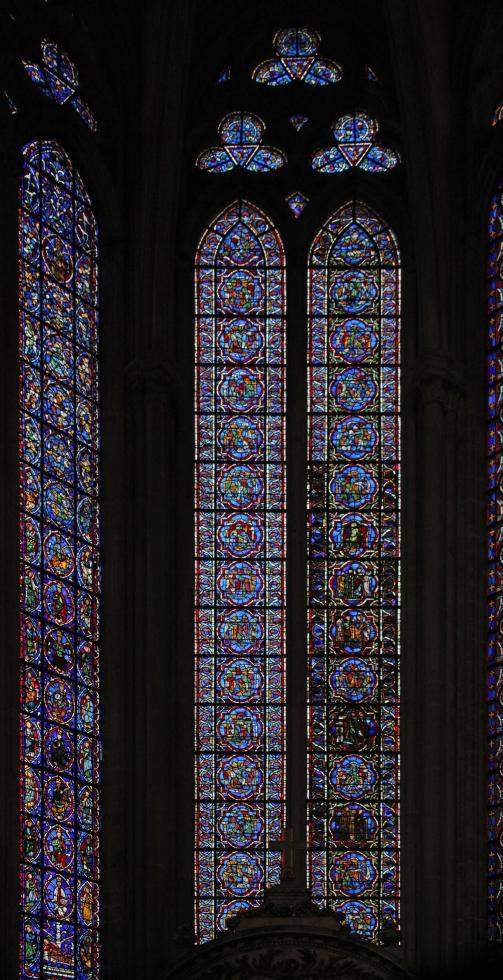
Cathedral of St. Peter and St. Paul, Troyes, Champagne-Ardennes, France


Cathedral of St. Peter and St. Paul, Troyes, Champagne-Ardennes, France
<http://mappinggothic.org/archmap/media/buildings/001000/1055/images/300/1055_00006_w.jpg> 

Nave of the Cathedral of St. Peter and St. Paul, Troyes, Champagne-Ardennes, France.
<http://mappinggothic.org/archmap/media/buildings/001000/1055/images/700/1055_00036_w.jpg>


     The Cathedral of St. Peter and St. Paul is located in Troyes, a town in the Aube district of the Champagne-Ardennes region of France.  The town dates to the Roman occupation of Gaul.  The town grew up on the Seine River where a number of roads came together including the Via Agrippa.  At the end of the Roman Empire, the town went by the name of Tricassium, from which the name of Troyes was derived.  Apparently the town was the seat of a Roman Catholic bishop from the 4th century.  Several churches must have existed on the site of the present cathedral.  A Romanesque cathedral was significantly damaged by fire in 1188, but it must not have been completely destroyed because it was about 20 years later before the Gothic rebuilding began in approximately 1208.

     Money and politics seem to have played a significant part is the progress or lack thereof in the building of the church.  Thibaut III (also known as Theobold III), Count of Champagne, ruled from 1197 to 1201, his death.  He seems to have been instrumental in raising money and enthusiasm for the Fourth Crusade called by Pope Innocent III in 1198.  Money and debts accrued to pay for the crusades removed money that would have been available for building and rebuilding churches.  The lack of money impeded the economy of Champagne and left no money for patronage of major building projects such as the Cathedral.  After the death of Thibaut III, his wife, Blanche of Navarre, ruled as regent for 21 years since her son, Thibaut IV, was born shortly after his father's death.  The rule by Blanche of Navarre and the succession of her son, Thibaut or Theobold IV, was contested during almost the whole period of the regency.

     Given the chronic problem with money, the Troyes Cathedral was built incrementally. The east of the cathedral was built first including the choir, apse, radiating chapels and transepts. The hand of two master masons has be identified in the choir area built up to about 1220. Then the upper portions of the choir were built by a third master mason. Building was disrupted by two additional problems.  The first was a "whirlwind" that destroyed the upper portions of the choir in 1228.  Contemporary accounts say the church was destroyed, but subsequent rebuilding proved that there was major damage but not total destruction. 

     The following year, in 1229, a league of barons allied to King Louis VIII of France waged a war against the Count of Champagne, Thibaut IV (also known as King Theobold I of Navarre).  This conflict may have caused further damage to the newly rebuilt church or, at the very least, drained away even more money that could have been used for the construction and glazing of the cathedral. This war further depleted the economy of Champagne. The romantic version of the conflict explains the war as jealously over a supposed relationship between Thibaut IV and his cousin Blanche of Castile who was the widow of Louis VIII.  Blanche was a granddaughter of Eleanor of Aquitaine and Thibaut IV was a great-grandson of Eleanor of Aquitaine.  The more likely conflict was money and the status of Jews living in Champagne. Champagne had a prosperous Jewish population.  Blanche of Navarre as regent had gained significant income from higher taxes imposed on the Jews in return for guarantees of safety.  This money then helped her finance the conflicts over succession of her son as Count of Champagne.  Once Thibaut IV became King of Navarre on the death of his uncle-in-law, his position politically and financially became too strong to assail.  He did have to buy-off other claimants to the rule of Champagne.
  
     Because of the step-wise completion of the Troyes Cathedral, construction apparently halted after the eastern half of the church was built for some years.  Construction of the remainder of the cathedral including nave and towers continued through the 16th century.

     The Tree of Jesse stained glass window was made in all likelihood for the eastern axial chapel of the Cathedral of Troyes during the first period of construction. The window seems to have been made in two periods, before the storm on 1228 and then after the storm of 1228.  The older glass is dated to about 1210, and the younger glass is dated to 1230-1240.  It  is possible that some of the glass was damaged during the collapse of the choir and took some time before repairs would have been put in place.  The reconstruction of the choir took precedence over continued glazing of the windows.  

     As noted in the earlier blog, the present Jesse Tree window at Troyes lacks the prophets usually found in Jesse Tree windows. The window is mostly a 19th century reconstruction that is located in a position of the north side of the choir in Bay 31 or window # nXVII.  The central Jesse Tree is white with white mandorlas with red accents surrounding the four kings, Jesse, Virgin Mary and Christ Jesus.


Jesse Tree window from Troyes Cathedral Bay 31. Jesse is reclining on his bed.  King David is playing a vielle.  King Solomon is writing in a book or playing a cithara.  Two generic kings of Judah hold scepters. Virgin Mary is holding a palm branch. Christ is enthroned with his right hand in blessing and holding a book, the Gospels.
<https://upload.wikimedia.org/wikipedia/commons/thumb/7/70/Vitrail_Arbre_de_Jess%C3%A9_Cath%C3%A9drale_Troyes_200208_1.jpg/44px-Vitrail_Arbre_de_Jess%C3%A9_Cath%C3%A9drale_Troyes_200208_1.jpg>

Original 13th century glass in Jesse Tree window at Troyes as estimated by Professor Elizabeth Pastan.

     In the above image, Professor Elizabeth Pastan has drawn the putative original glass in the current mostly 19th century Jesse Tree window.  Parts of  Jesse, and Kings David and Solomon are original as is part of the generic king of Judah, the Virgin Mary and Christ Jesus in majesty.

     If art historians are correct that the Tree of Jesse window was located in the easternmost chapel of the Cathedral.   Apparently the window was removed in 1779 when a sculpture, Descent from The Cross, was installed in the chapel.  Further, some panes of what appeared to be Jesse Tree stained glass was noted among the broken glass found after the French Revolution.  According to written descriptions from the first half of the 19th century, some of the Jesse Tree panels appeared within other windows of the ambulatory chapels.  In 1869, the restored Jesse Tree window was returned to the choir, without the prophets.  The Victoria and Albert Museum acquired ten Jesse Tree prophet panels in 1881.
  
    As far back as 1958, the art historian Dr. Louis Grodecki noted that the prophet panels in the Victoria and Albert Museum in London "were of similar quality as that of the stained glass of Troyes."  Professor Pastan in her examination of the window at Troyes and the prophet panels in London, makes a solid argument that the Victoria and Albert museum panels are the missing panels from Troyes.  Her argument has four points: (1) the height of the Troyes' king panels and the height of the prophet panels are the same (2) the width of the original king panel plus two prophet panels fit the size of the axial chapel windows with space for leading and armatures, (3) the glass at the Victoria and Albert and the Cathedral of Troyes have similar pitting and aging, and (4) the palette of colors used in the prophet panels and the Troyes Cathedral Jesse window are the same.  The color palette is quite different from the 19th century restoration glass.
     
     Professor Pastan comments that there are some problems with her attribution.  There are differences in the styles and size of the prophet figures, between the prophet figures and the kings, differences in the handling of the cloth, drawing the hair, and the standing positions of the prophets (contrapposto positions). 

    Yet the relationship between the prophet panels is confirmed by the fact that two sets of the figures use the some cartoon but are mirror images.  These are Daniel and Aaron, and Abacus (Habakkuk) and Helpas (Helias or Isaiah).

Top of the Jesse Tree lancet window at Troyes Cathedral.  Detail of Christ Jesus and St. Mary holding a palm branch.
<https://upload.wikimedia.org/wikipedia/commons/thumb/c/cb/Vitrail_Arbre_de_Jess%C3%A9_Cath%C3%A9drale_Troyes_200208_5.jpg/77px-Vitrail_Arbre_de_Jess%C3%A9_Cath%C3%A9drale_Troyes_200208_5.jpg>

Generic king of Judah.  This is a 19th century replacement panel
<https://upload.wikimedia.org/wikipedia/commons/thumb/3/36/Vitrail_Arbre_de_Jess%C3%A9_Cath%C3%A9drale_Troyes_200208_4.jpg/120px-Vitrail_Arbre_de_Jess%C3%A9_Cath%C3%A9drale_Troyes_200208_4.jpg>

Generic king of Judah.  Note that head is a different scale than the remainder of the body.  The head is a 19th century replacement.
<https://upload.wikimedia.org/wikipedia/commons/thumb/7/74/Vitrail_Arbre_de_Jess%C3%A9_Cath%C3%A9drale_Troyes_200208_3.jpg/120px-Vitrail_Arbre_de_Jess%C3%A9_Cath%C3%A9drale_Troyes_200208_3.jpg>

King Solomon playing a cithara, a type of lyre.
<http://www.therosewindow.com/pilot/Troyes%20cathedral/images/w31-3-CAN_2209.jpg>

King David bowing a waisted vielle.  Mostly 13th century glass.
<https://upload.wikimedia.org/wikipedia/commons/thumb/9/96/Vitrail_Arbre_de_Jess%C3%A9_Cath%C3%A9drale_Troyes_200208_2.jpg/120px-Vitrail_Arbre_de_Jess%C3%A9_Cath%C3%A9drale_Troyes_200208_2.jpg>


Two panels of prophets from the Victoria and Albert.  Note that Aaron (top) and Daniel (bottom) are mirror images.  The Daniel is spelled backward, undoubtedly an error that occurred when the cartoon was reversed. 
<http://media.vam.ac.uk/media/thira/collection_images/2009CE/2009CE2261_jpg_o.jpg
http://media.vam.ac.uk/media/thira/collection_images/2009CE/2009CE2267_jpg_o.jpg>


Helpas or Helias, the Vulgate Latin for Isaiah (top) and Abacus or Habakkuk (bottom) are mirror images though it would appear that two different persons did the painting because of differences in handling of the material of the clothing, hands and other details in the panels.
<http://media.vam.ac.uk/media/thira/collection_images/2009CE/2009CE2266_jpg_ds.jpg
http://media.vam.ac.uk/media/thira/collection_images/2009CE/2009CE2263_jpg_o.jpg>


Two unidentified prophets with similar, mirror image designs.  These prophets are not identified though the designs of the window and border are virtually identical to the other panels.  Again, it appears as though the figures are painted by two different persons because of the difference in details. 
<http://media.vam.ac.uk/media/thira/collection_images/2009CE/2009CE2273_jpg_o.jpg
http://media.vam.ac.uk/media/thira/collection_images/2009CE/2009CE2272_jpg_o.jpg>

Professor Pastan noted that Ezekiel, spelled EXECHYEL, in the stained glass panel, is stylistically similar to Daniel, Helpas (Helias or Isaiah), Habakkuk and Aaron.  There are enough differences though to suggest that they were made by different artisans and perhaps at somewhat different time periods.
<http://media.vam.ac.uk/media/thira/collection_images/2006AJ/2006AJ8028_jpg_o.jpg>


Another two prophets that appear to be reversed cartoons.  The top prophet is unidentified and the bottom panel is Moise or Moses.
<http://media.vam.ac.uk/media/thira/collection_images/2009CE/2009CE2268_jpg_o.jpg
http://media.vam.ac.uk/media/thira/collection_images/2009CE/2009CE2270_jpg_o.jpg>


 Roboan is Rehoboam who was King of Judah and not a prophet (though the "prophet" part of the scroll is a repaired section).  Professor Pastan pointed out the fact that this panel appears to be most similar to King David and Solomon from the remaining Jesse tree  when  comparing size and style of the figure.  None of the other prophets are quite the same the Rehoboam.
<http://media.vam.ac.uk/media/thira/collection_images/2009CE/2009CE2264_jpg_o.jpg>


      A reconstructed Jesse Tree might look a bit like the picture below if panels at the Victoria and Albert Museum could be married to the Jesse Tree panels at the Cathedral in Troyes.

I cannot say that I am very pleased with this effort.  So I will probably try again with the reconstruction.  So, if you come back again, you will probably see another picture.

References

Brad Lenz, Henrietta Miers, Crystal Terry, and Hanna Wiegers. "Troyes Cathedral: Stained Glass, God instructing Adam & Eve at the Tree of Knowledge. "<http://sites.duke.edu/medren290stainedglass/> (August 16, 2015)

Elizabeth C. Pastan. "Fit for a Count: The Twelfth-Century Stained Glass Panels from Troyes." Speculum, (Apr. 1989) 64: 338-372.

Elizabeth C. Pastan. "'And He Shall Gather Together the Dispersed' The Tree of Jesse at Troyes Cathedral." Gesta (1998) 37(2):232-239.

Charles T. Little, "Membra Disjecta: More Early Stained Glass from Troyes Cathedral, Gesta, (1981). 20(1) 119-39.

Stephen Murray, Building Troyes Cathedral: The Late Gothic Campaigns, (1987) Indianapolis: University of Indiana,  He also has a  very useful website: Mapping Gothic France.  <http://mappinggothic.org/>

Louis Grodecki. "De 1200 a 1260".in  Marcel Aubert, Le vitrail francais (1958) Paris: Editions 2 monde.

V & A: Search the collections

Painton Cowen, Therosewindow.com 
http://www.therosewindow.com/pilot/Troyes%20cathedral/images/w31-CAN_2209-11.JPG (Augsut 15, 17, 18, 2015).


Thursday, August 13, 2015

The Single Lancet Jesse Tree Window in France: Reading a Jesse Tree Window, Part B

     The spectacular French Gothic Cathedral of Our Lady, Amiens, Picardy, France was started about 1220, a rebuilding project because of destruction of earlier cathedrals by fire.  The oldest stained glass at Amiens is dated to about 1250 or 1260 with subsequent restorations in the 19th and 20th century.   The cathedral of Amiens was damaged during the Wars of Religions, as well as,  from bombs and missiles during World War I.  The Jesse Tree window is in the choir of the church (Cowen window # 14). The Amiens Jesse window is notable for its use of blue.  Of the 17 main divisions within the window, nine date from the 13th century or are substantially from the 13th century.  The Jesse figure at the bottom is a replacement. Eight of the kings are originals including David and Solomon.  At the top of the window, only the figure of the Virgin Mary is original glass (Painton Cowen).


Note that Jesse window is to the left of this picture.
Photo credit for all pictures:  Painton Cowen
<http://www.therosewindow.com/pilot/Amiens/w14-Frame.htm>

Whole Jesse Tree window.  Details below. 
<http://www.therosewindow.com/pilot/Amiens/images/w14-whole-IMG_2741-44.jpg>

Generic King of Judah holding a scepter.
<http://www.therosewindow.com/pilot/Amiens/images/w14-level6.jpg>

Generic King of Judah with left hand holding to Jesse Tree vine
<http://www.therosewindow.com/pilot/Amiens/images/w14-level5.jpg>

Generic King of Judah playing a vielle.  This is the panel above King Solomon.
<http://www.therosewindow.com/pilot/Amiens/images/w14-level4.jpg>

King Solomon above King David.  Solomon is holding a scepter. He appears to be virtually identical of the other kings holding scepters.
<http://www.therosewindow.com/pilot/Amiens/images/w14-level3.jpg>

King David playing seven string lyre with what appears to be a bow.  Lyres were instruments from the Byzantine Empire that were probably introduced to France as a result of the Crusades. 
<http://www.therosewindow.com/pilot/Amiens/images/w14-level2.jpg>
   
     The Jesse Tree window at Amiens is tall, though the window at St. Chapelle may be taller.  In addition to Jesse, Kings David and Solomon, Virgin May and Jesus Christ in majesty, there were eleven kings of Judah portrayed.  All are posed frontally.  Many of the prophets hold banderoles but there are no identifying names.
    
     After a fire in 1188 destroyed the Romanesque Cathedral of  St. Peter and St. Paul in Troyes, Champagne, France, a new cathedral was started about 1208.  The first part of the cathedral to be built in the new Gothic style was the choir.  It is in the choir, that the Jesse Tree window resides.  The stained glass windows in the choir date from about 1220, older than the Jesse Tree at Amiens.  Like Amiens, it is a substantially blue window. In the 21st century, about half the window is original glass and about half is 19th century replacement glass.  Again the figures are frontally posed. In the Troyes' Jesse Window, King David plays the vielle, an acknowledgement of his authorship of the Psalms.  The King Solomon above David is writing in a book. (French art historians identify the rectangular object in Solomon's hands as a cithar, a form of lyre.  Both would succeed as symbols for Solomon, either as a author of wisdom literature or as the writer of the Song of Solomon). Much of the Jesse Tree is a grape vine with many clusters of grapes, especially appropriate for Champagne, France.  Another interesting design feature of the genealogy of Jesus in the Troyes window is the lack of prophets or other Old Testament references except for the kings. (More about this when I write about Troyes Cathedral.)

The whole Jesse Tree, 13th and 19th century at Troyes, Cathedral of Sts. Peter and Paul.
Photo Credit for all photos: Painton Cowen
<http://www.therosewindow.com/pilot/Troyes%20cathedral/images/w31-CAN_2208.JPG>

 Virgin Mary, seated and holding a lily in her right hand.
 <http://www.therosewindow.com/pilot/Troyes%20cathedral/images/w31-6-CAN_2208.jpg>

King Solomon writing in a book.
<http://www.therosewindow.com/pilot/Troyes%20cathedral/images/w31-3-CAN_2209.jpg >

King David playing a waisted vielle.
<http://www.therosewindow.com/pilot/Troyes%20cathedral/images/w31-2-CAN_2209-11.jpg>