This short post is a brief response to JBP who is researching textiles with Jesse Tree images. I have not systematically looked at fabrics for Jesse Tree images. Despite their extraordinary beauty, liturgical fabrics are very perishable. Though most of the fabric is silk or linen with metallic threads, these fabrics are frequently used and become soiled, frayed, worn, and are subject to changes in style, even if style changes are generally slow. These garments, covers, and cloths are ephemeral.
The ecclesiastical pictorial embroidery is called
opus angelicanum (English work). It was extremely popular from the mid 13th century-mid 14th century in Europe. Most of it was made by professional embroiderers in London. An article about
Opus Anglicanum on the Victoria and Albert Museum website commented that an 1295 Vatican Inventory listed over 100 examples. <http://www.vam.ac.uk/content/articles/i/english-embroidery-introduction/ .
This first is a cope in the Victoria and Albert Museum in London. This particular cope was made about 1295-1315. It was cut-up, perhaps to serve another purpose such as an altar cloth or frontal, and it was reassembled by the museum. In this Jesse Tree presentation, the names of the figures are embroidered, allowing for identification of kings and prophets.. This is appended to the pictures on the website:
... copes of red samite decorated with the Tree of Jesse are frequently mentioned
in the reigns of Henry III and Edward I.. There was one at St Paul's Cathedral
in 1245; Bishop Middleton of Norwich (1278-88) gave one to Canterbury,
and Bishop Bitton (1292-1307) gave one to Exeter. Stylistically, this example
is related to the Vatican cope in the Museo Sacro of the Vatican Library, Rome,
the copes of Saint Bertrand de Comminges, and the John of Thanet panel
(V&A T.337-1921).
<http://collections.vam.ac.uk/item/O121306/cope-unknown/>
The figures in the cope were apparently arranged in the round half-circle cope. The top of the Jesse Tree is the Virgin Mary seated with Jesus as a toddler.
<http://media.vam.ac.uk/media/thira/collection_images/2006BD/2006BD4809_jpg_l.jpg .
Crowned and seated Virgin Mary with a gold nimbus holding a standing toddler, Jesus. Jesus is holding his right hand in a gesture of blessing. He has a cross nimbus.
<http://media.vam.ac.uk/media/thira/collection_images/2006BJ/2006BJ7210_jpg_l.jpg>
Old Testament prophet wearing a pointed yellow Jewish cap. I cannot quite read the name but the banderole contains the contraction PPHE for prophet.
<http://media.vam.ac.uk/media/thira/collection_images/2006BD/2006BD4808_jpg_l.jpg>
Jesse reclining with a grape vine arising from his thigh. Above him is King David playing his harp.
<http://media.vam.ac.uk/media/thira/collection_images/2006AY/2006AY5177_jpg_ds.jpg>
The next item is also from the Victorian and Albert Museum. It is an orphrey, the name given to the vertical bands of cloth that can be attached to a chasuble, dalmatic, or cope. This particular piece of opus angelicanum has made about 1310-1340.
Detail of King David playing a harp
<http://media.vam.ac.uk/media/thira/collection_images/2012FN/2012FN0820_jpg_ds.jpg>
Detail of the Virgin Mary dressed as an elegant young queen. She appears to be holding a piece of fruit in her right hand. (Perhaps this is based on the apocryphal legend that is the basis of the Cherry Tree carol.) St. Mary is without a nimbus. The toddler sized Jesus is seated in her lap holding his right hand up in blessing.
<http://media.vam.ac.uk/media/thira/collection_images/2012FN/2012FN0828_jpg_l.jpg>
The Cleveland Museum of Art has part of an orphrey band made about 1350. The fragment of the Jesse Tree has three kings of Judah enclosed within a grape vine, a reference to the Holy Eucharist. The figures are identified as Achim, Ezechias, and Eliud. The kings are seated on the tendrils of the grape vine.
<http://artimages.clevelandart.org/cma/ump.di?e=6B7FEB21D4399EA0B1AF9E04A475029C86BB3F7B3DE803E5220A8E63605BAA41&s=21&se=1874351001&f=1949.503_w.jpg>
The fourth item I will mention is from the Musee des Tissus, Lyon, France. It appears to be an orphrey that perhaps was attached to a chasuble. It was made in England, probably London, from 1315-1335. At the bottom is a reclining Jesse. Above him is King David playing a harp. Then there is another king before the seated Virgin Mary holding a toddler Jesus. This orphrey is topped by a rough cut green wooden cross crucifixion scene with St. Mary and St. John. The vine is a grape vine. The panel is a mirror image of the usual arrangement of figures for a Jesse Tree.
<http://unartanglais.files.wordpress.com/2014/02/03.jpg?w=95&h=240>
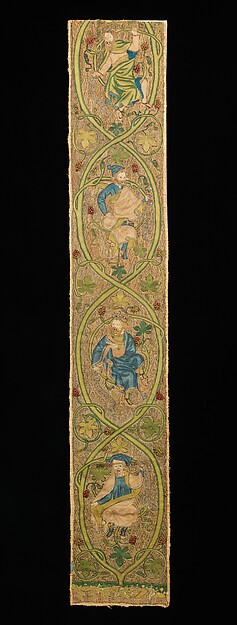
The Metropolitan Museum of Art has a Jesse Tree orphrey in its collection that appears to be both prophets and kings holding on to a grape vine. It is dated 1350-1375. The style of embroidery is similar to the piece in the Cleveland Museum of Art.
http://images.metmuseum.org/CRDImages/md/original/49.216_CP4.jpg
The embroidered Jesse Trees are very similar in style to the illuminated manuscripts of the same period. One can say that the embroidered Jesse Trees are an extension of manuscript illumination.